



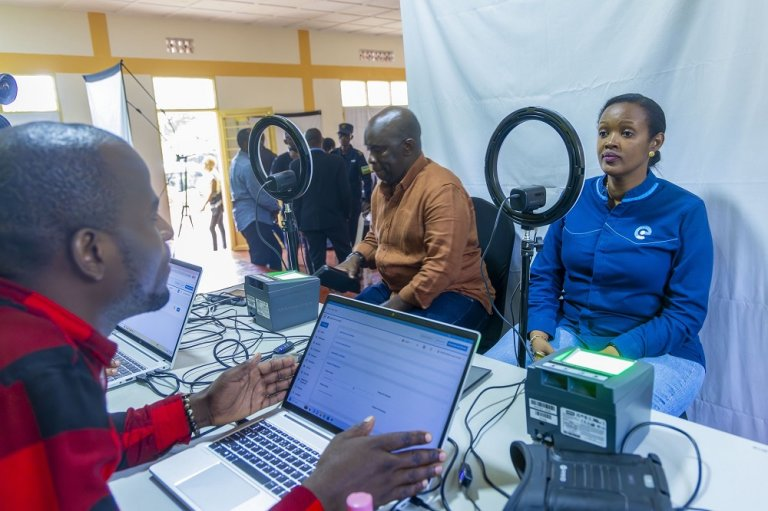
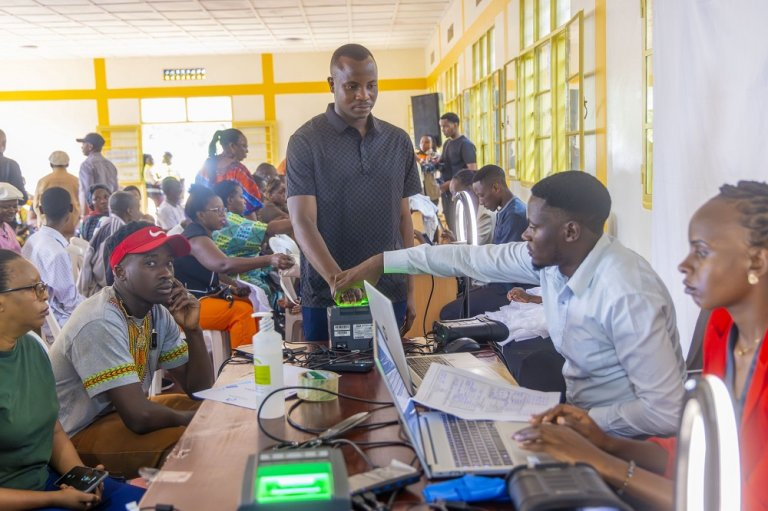
More than 1.8 million people have already been photographed and registered under Rwanda’s national digital identity initiative, known as e-Ndangamuntu, according to the Ministry of ICT and Innovation.
Speaking before Senators on February 24, 2026, the Minister of ICT and Innovation, Paula Ingabire, confirmed that 1,828,763 individuals have so far completed biometric enrollment as part of the ongoing rollout.
What Is e-Ndangamuntu?
The e-Ndangamuntu is a permanent, unique digital identity assigned to every Rwandan citizen from birth. It is designed to securely integrate interactions between individuals and both public and private institutions.
The government plans to register at least 15 million people, including Rwandan citizens, refugees, migrants and other residents. The project, which has attracted an investment exceeding $50 million, aims to modernize service delivery nationwide.
Districts Covered So Far
Registration has been completed in nine districts, including three pilot districts:
- Huye
- Nyanza
- Gisagara
The program has since expanded to:
- Kamonyi
- Muhanga
- Ruhango
- Nyarugenge
- Gasabo
- Kicukiro
The government aims to complete biometric data verification for all eligible citizens by the end of 2026. Issuance of digital IDs is expected to begin in August 2026 for those who have finalized registration.
How the Digital ID Will Be Used
The digital ID will be integrated into multiple services across different life stages.
For Children
At birth registration through the Civil Registration and Vital Statistics (CRVS) system, a child will automatically receive a digital ID upon parental confirmation. It will facilitate school enrollment, vaccination tracking and healthcare services.
For Youth
Teenagers will use the ID for academic records, national exams, university enrollment, driving licenses and first employment documentation.
For Adults
For adults, the digital ID will link to:
- Tax services
- Banking
- Healthcare
- Land services
- Marriage registration
- Voting
- Business registration
- Pension services
In healthcare, the system will integrate insurance information, medical records, prescriptions and vaccination history.
Privacy and Data Protection
Minister Ingabire emphasized that the system is not intended for daily surveillance. Personal data will be securely stored, and access will require explicit citizen consent.
Under Rwanda’s data protection law, any breach must be reported within 72 hours to the National Data Protection Office (NDPO). Citizens retain the right to request corrections or seek compensation in case of misuse.
The system is designed to share only minimal necessary data. For example, a bank may verify that a person is over 18 years old without accessing their full date of birth. Citizens can revoke data-sharing permissions at any time.
Three Forms of Digital Identification
The e-Ndangamuntu will be available in three formats:
- Smart Card with QR Code – Contains essential information and allows service providers to verify identity securely.
- Digital ID Number – Used after biometric authentication.
- Token System – A secure substitute number for digital transactions based on biometric verification.
The government says this multi-option approach ensures that every citizen can choose the most convenient verification method.
Accessibility for All Citizens
For individuals without smartphones, alternative solutions such as physical cards and USSD-based systems will be available. District-level staff will assist those lacking digital literacy to ensure no one is excluded from accessing services.
Senators Welcome the Initiative
Members of the Senate praised the project for modernizing Rwanda’s service delivery and reducing reliance on multiple physical documents.
They highlighted the importance of expanding reliable, high-speed internet nationwide to fully support digital services.
A Step Toward Digital Transformation
Rwanda’s e-Ndangamuntu represents a major step toward digital governance, aiming to streamline service delivery, enhance security and improve citizen convenience.
With over 1.8 million already enrolled, the project is gaining significant momentum as the country moves closer to a fully integrated digital identity system.
Related posts:
 Alyn Sano reflects on global connections at NAMM Show 2026
 Nick Cannon Reveals Mariah Carey Breakup Sparked His Trauma and Led to Having Many Children
 Karate Belt Ranking
 IShowSpeed Visits Rwanda for Gorilla Trekking
 Nicole Kidman and Keith Urban Split After 19 Years of Marriage
 Trump Proposes 100% Tariff on Foreign-Made Films, Sparking Global Industry Concerns
 IShowSpeed Plans to Visit Rwanda’s Mountain Gorillas
 The 10 Best Places to Travel in 2025
 Bruce Melodie: The Rise of Rwanda’s Music Icon – Biography, Career, and Achievements
 Platini and Nel Ngabo Shoot Videos in Zanzibar
 Ryanair Mocks Elon Musk Over Claims He Wants to Buy the Airline
 15-Year-Old Owen Cooper Makes Emmy Awards History
 Kigali Universe to Open Frw900 Million Footbridge
 Kenyan Music Stars Bensoul and Nviiri The Storyteller to Perform in Kigali During UCI Road World Championships
 Bwiza and Chriss Eazy to Perform at UCI Closing Ceremony
 A$AP Rocky Reveals His Mother Pushed Him to Date Rihanna Years Before Their Romance
 Cardi B pregnant with Stefon Diggs’ child, replacing Offset
 Who Is iShowSpeed, the Internet Star Visiting Rwanda?
 From Studio to Stardom: Yago Thrilled by Album’s Turnover
 Man Arrested for Allegedly Stealing Unreleased Beyoncé Songs
Hi! This is kind of off topic but I need some
guidance from an established blog. Is it hard to set up your own blog?
I’m not very techincal but I can figure things out pretty quick.
I’m thinking about creating my own but I’m not
sure where to start. Do you have any tips or suggestions?
Thank you
โพสต์นี้ อ่านแล้วได้ความรู้เพิ่ม ค่ะ
ผม ไปอ่านเพิ่มเติมเกี่ยวกับ ข้อมูลเพิ่มเติม
สามารถอ่านได้ที่ g2g59
สำหรับใครกำลังหาเนื้อหาแบบนี้
มีการยกตัวอย่างที่เข้าใจง่าย
ขอบคุณที่แชร์ คอนเทนต์ดีๆ นี้
จะรอติดตามเนื้อหาใหม่ๆ
ต่อไป