



NASA continues to push the boundaries of human space exploration as astronauts aboard the Artemis II mission begin their journey back to Earth after completing key milestones around the Moon.
The four astronauts successfully reestablished communication with mission control after a planned 40-minute signal blackout. This interruption occurred while their spacecraft, Orion, traveled behind the far side of the Moon, a region where communication with Earth becomes temporarily impossible.
During the mission, the crew reached a record-breaking distance of 406,771 kilometers from Earth. This achievement surpasses the previous record set during Apollo 13 in 1970, marking a new milestone in human space travel.
Rare Astronomical Events Observed
While in deep space, the astronauts witnessed a total solar eclipse that lasted approximately 35 minutes. The Moon completely blocked the Sun, allowing them to observe the Sun’s outer atmosphere, a view rarely seen even from Earth.
One astronaut described the moment as similar to scenes from science fiction, highlighting the uniqueness of the experience. These observations contribute valuable insights into solar activity and space conditions.
Close Study of the Moon
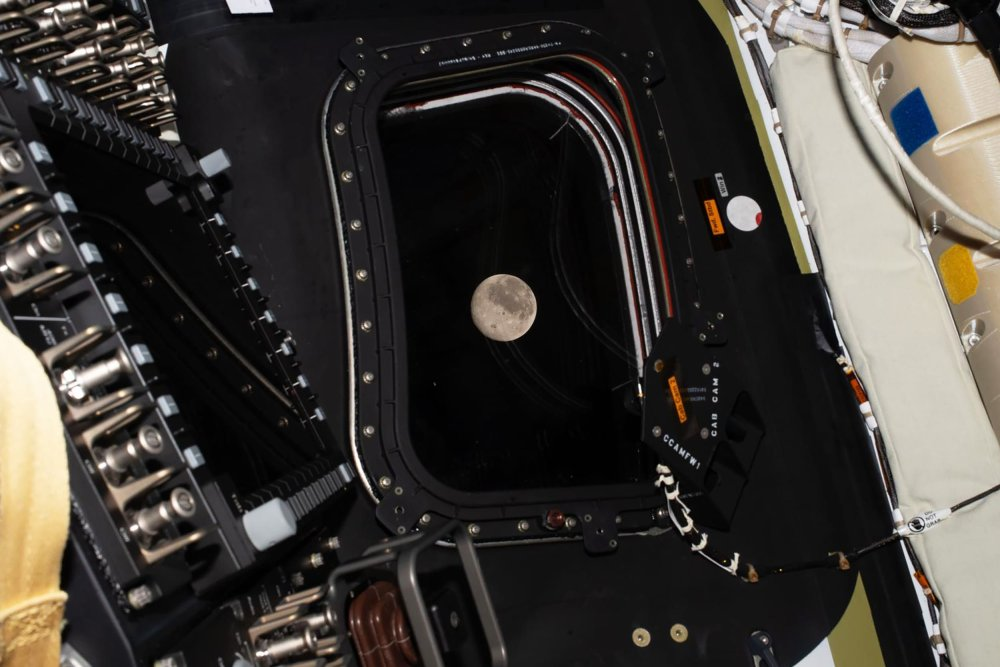
As the spacecraft orbited the Moon, it passed at an altitude of about 9,000 kilometers above the lunar surface. This allowed the crew to conduct detailed observations and capture high-quality images.
The astronauts documented large craters, lunar dust formations, and bright flashes caused by space rocks impacting the Moon’s surface. These findings may support future missions and scientific research related to lunar geology.
In addition, the crew identified a distant object believed to be Venus, further demonstrating the mission’s observational capabilities.
Human Element in Space Exploration
Beyond scientific achievements, the astronauts also made a symbolic request. They asked mission control to name a lunar crater after the late wife of their mission leader, reflecting the personal connections that remain strong even during space missions.
Implications for Future Missions
The success of Artemis II reinforces NASA’s long-term goal of returning humans to the Moon and eventually sending crews to Mars. The mission provides critical data on long-distance space travel, communication systems, and human performance in deep space.
It also highlights the importance of international competition and collaboration in space exploration, as countries and private companies continue to invest heavily in lunar and planetary missions.
Conclusion
Artemis II represents a major step forward in human space exploration. From record-breaking distances to rare astronomical observations, the mission showcases both technological progress and human curiosity.
As the astronauts return safely to Earth, their findings will help shape the future of space travel and deepen our understanding of the universe.
Related posts:
 iPhone 17 Pro: What You Need to Know about iPhone 17 Pro
 National Bank Reports Drop in Digital Payment Fraud Cases
 Scientists Discover Massive Mysterious Rock Beneath the Bermuda Triangle
 Solar Storms Could Disrupt Satellite and GPS Operations
 Spotify Invests $10 Billion to Boost Artist and Podcast Monetization
 Tesla’s Game-Changing Pi Phone Is Almost Here — Everything CEOs & Innovators Should Know
 AI Mammography Improves Breast Cancer Detection While Reducing Radiologist Workload
 TikTok US entity deal finalized to avoid ban
 Taking Down “Quackers”: Inside a Global Dark Web Investigation
 You must have these 5 apps in your phone 2025
 WhatsApp Plans Advertising Rollout with Optional Paid Subscription
 Elon Musk Plans Terafab Chip Factory in Texas to Boost AI and Automotive Innovation
 SpaceX Provides Free Starlink Access During Natural Disasters
 NASA Plans $20 Billion Lunar Base to Accelerate Artemis Mission
 Google Launches Live Translation Feature for Real-Time Multilingual Conversations
 China’s 16-Ton Jiutian Drone Completes Historic First Flight
 SpaceX and xAI Join Forces in Elon Musk’s Plan to Build AI Data Centers in Space
 Microsoft and Nvidia Partner to Accelerate Nuclear Energy with AI
 Apple Acquires Israeli AI Audio Startup Q.ai
 Taiwan suspends RedNote for one year