


Google has unveiled a major redesign of its popular mapping service, Google Maps, introducing new artificial intelligence features designed to help users discover places and navigate more easily.
The update integrates advanced AI technology from Gemini, marking one of the most significant changes to the platform used by more than 2 billion people worldwide.
“Ask Maps” Lets Users Ask Complex Questions
One of the key additions is a feature called Ask Maps, which expands the conversational capabilities previously introduced to Google Maps.
With Ask Maps, users can ask detailed questions that traditional maps could not answer. For example, people can request:
- Nearby places to charge their devices
- Cafés with shorter waiting lines
- Suggestions for restaurants or attractions
- A detailed road‑trip itinerary with multiple stops
The feature uses a massive database containing over 300 million places and reviews from more than 500 million contributors gathered since Google Maps launched more than two decades ago.
Initially, Ask Maps will be available in the mobile app for iPhone and Android users in the United States and India, with plans to expand to other countries and computers later.
Immersive Navigation Introduces 3D Driving Guidance
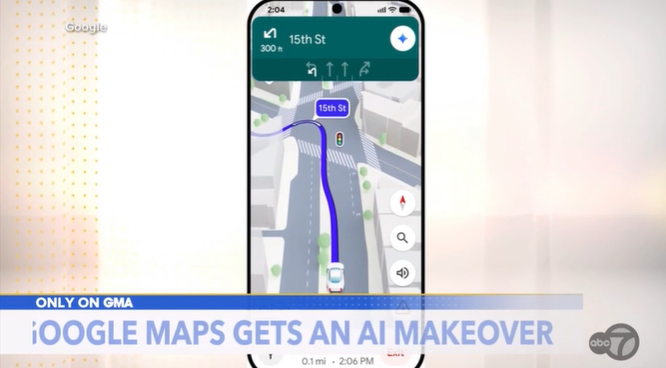
Google is also introducing Immersive Navigation, a new AI‑powered navigation tool that provides a 3D view of the surrounding environment.
This feature displays landmarks such as:
- Notable buildings
- Road medians
- Nearby terrain and surroundings
The 3D perspective is designed to help drivers better understand their location and surroundings while navigating.
Immersive Navigation will also help explain the advantages and disadvantages of different routes, including traffic conditions and travel time, and suggest the best places to park near a destination.
At launch, the feature will be available in the United States through the Google Maps mobile app on iPhone and Android, as well as vehicles equipped with Apple CarPlay or Android Auto.
Preventing AI Errors
Google said its improved AI safety systems should prevent the Gemini technology from generating incorrect or nonexistent locations an issue in AI systems often called “hallucination.”
The company believes these guardrails will ensure that navigation recommendations remain accurate and reliable.
Part of Google’s Broader AI Strategy
The expanded use of AI in Google Maps follows recent efforts by Google to integrate Gemini technology into other major products such as Gmail and Google Chrome.
These updates are part of Google’s broader push to strengthen its position in the rapidly evolving artificial intelligence industry.
The competition for leadership in AI is intensifying, with companies such as OpenAI and Anthropic also developing powerful AI models.
Google executives say the new features highlight their confidence in the Gemini 3 AI model, which was introduced late last year.
Related posts:
 TikTok Deal Gives U.S. Investors Majority Control, Avoids Ban
 WhatsApp Plans Advertising Rollout with Optional Paid Subscription
 Rwanda Launches Home-Based Cervical Cancer Self-Screening Program
 France Fines Google and Shein Over 800 Billion Rwandan Francs for Privacy Violations
 Google Not Required to Sell Chrome or Android, U.S. Court Rules
 Anthropic Challenges Pentagon Decision to Label Company a National Security Risk
 Digital platforms reshape how job seekers connect with employers
 Airtel Africa Partners With SpaceX to Expand Satellite Internet Across Africa
 ByteDance Signs Deal to Prevent TikTok Ban in the United States
 Rwanda Adopts Advanced Technology to Improve Disaster Communication Systems.
 China Launches Advanced Satellite to Test High-Level Communications
 Meta set to acquire Chinese AI firm Manus in major artificial intelligence push
 Concerns About AI Technology That Could Surpass Human Intelligence
 First Wheelchair User Reaches Space in Historic Mission
 WhatsApp to Introduce Stronger Privacy Controls to Protect User Messages
 How Programming Evolved Into AI Prompts
 Airbus Plans to Stop Using Google Cloud Over Data Security Concerns
 Samsung Launches Three-Panel TriFold Phone to dominate Apple and Huawei
 OpenAI Accuses DeepSeek of Using Its AI Technology
 Engineer Introduces Device That Turns Any TV Into Smart TV