


Robot technology is advancing rapidly worldwide, and Rwanda is beginning to adopt it in new sectors. Robots are now being used to serve customers in restaurants, marking another step in the country’s growing use of advanced technology.
Globally, more than 4.6 million robots are currently used in industries ranging from manufacturing to healthcare and agriculture. These machines are increasingly valued for improving efficiency, as in some tasks robots can perform work up to ten times faster than humans.
Global Growth of Robotics
Countries such as China have been early adopters of robotics technology. In 2024 alone, China introduced around 300,000 new robots, bringing the total number of robots operating in the country to more than two million.
Today, nearly 90% of companies in China consider artificial intelligence and robotics to be key tools for transforming their businesses.
The global robotics industry is also expanding rapidly. The market was valued at around $20.8 billion in 2025 and is expected to grow nearly seven times larger by 2032.
Robots are now used in many fields, including:
- Autonomous vehicles
- Medical procedures and surgery assistance
- Agriculture, including planting and harvesting
- Military operations and safety monitoring
For example, the robot Spot is widely known for its use in security, inspections, and detecting explosives.
Other advanced robots include Apis Cor, developed in Russia to build houses in less than 24 hours, and ReWalk from Israel, which helps people with spinal injuries walk again.
Rwanda Investing in Artificial Intelligence
Rwanda has also been investing heavily in artificial intelligence and robotics. In April 2023, the government approved a five‑year national policy aimed at accelerating the adoption of AI technologies.
Analyses suggest that $76.5 million will be needed to expand AI applications across different sectors of the economy. The government estimates that AI could contribute $589 million (about 6%) to the country’s GDP in the future.
These initiatives are supported by the expansion of high‑speed internet infrastructure, including the introduction of 5G connectivity in Rwanda.
Robots Now Serving Customers in Kigali
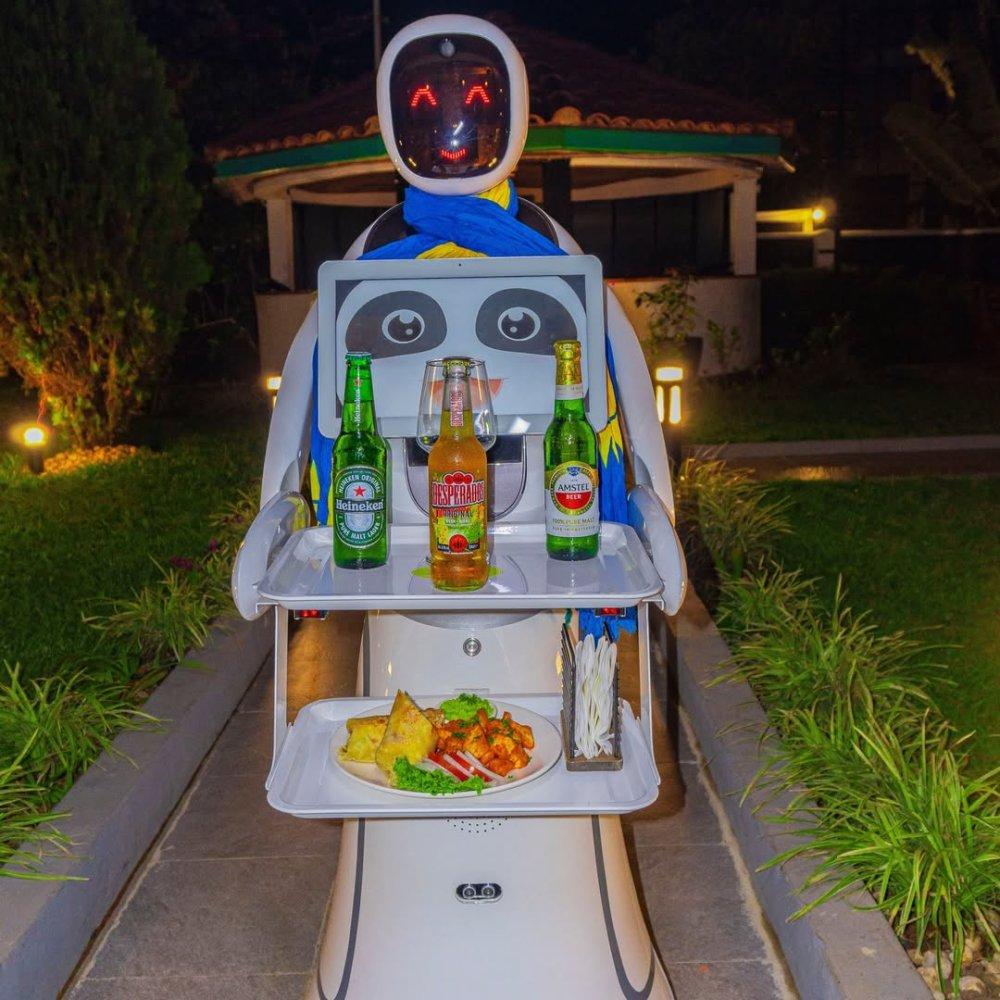
One of the most visible examples of robotics adoption in Rwanda can be seen at One Love Café.
The restaurant recently introduced two robots that assist with customer service. The robots, named Amahoro and Umoja, can deliver food and drinks directly to customers’ tables.
Using built‑in navigation technology, the robots can identify the correct table, carry the ordered items, and notify customers when their meals arrive.
They also have additional features, including:
- Promoting tourism in Rwanda
- Sharing messages about Kigali’s cleanliness
- Singing for customers celebrating birthdays
Bringing Innovation to Hospitality
Cynthia Umutoni, the manager of One Love Café, said the decision to introduce robots was part of the restaurant’s vision to embrace technological innovation.
According to her, the goal was to ensure the restaurant keeps pace with the digital era and offers customers a unique experience.
Some people initially worried that robots might replace human workers. However, the restaurant emphasized that this is not the case.
Technology Creating New Opportunities
Experts say that while automation may replace certain tasks, it will also create new jobs related to managing, maintaining, and regulating advanced technologies.
Studies estimate that around 150 million new jobs globally could emerge from AI and robotics in areas such as programming, maintenance, and robotics engineering.
High Cost of Robots
Robots remain expensive, which limits their adoption in many businesses.
According to Misgun Abraha Berne, the owner of One Love Café, robots are treated like employees but require significant investment.
Depending on their capabilities, robots on the international market can cost anywhere from Rwf2 million to over Rwf40 million. After shipping and taxes, the robots used by the restaurant cost between Rwf10 million and Rwf50 million.
He said more robots could be introduced in the future if customers respond positively to the innovation.
Innovation Driving Rwanda’s Service Sector
Innovation in the hospitality industry is increasingly important for Rwanda’s economy, particularly as Kigali continues to grow as a tourism and conference destination.
In the third quarter of 2025, Rwanda’s GDP reached Rwf5,525 billion, representing 11.8% growth compared to the same period the previous year.
The services sector accounted for 57% of GDP, followed by industry at 22% and agriculture at 15%.
Related posts:
 OpenAI Secures Data Center Partnership to Power ChatGPT
 How AI Is Transforming App Creation Through “Vibe Coding”
 Mark Zuckerberg Testifies in Court Over Allegations Against Meta
 OpenAI Discontinues GPT-4o Over Safety Concerns
 Russia Targets WhatsApp in Growing Battle With Foreign Tech Giants
 Canada Voices Growing Worry It Could Be Next After Trump’s Greenland Signals
 Spotify Updates Its AI DJ Feature Here’s What’s New
 China and the United States Compete to Build Data Storage Facilities in Space
 Grok Admits Security Flaw After AI-Generated Images of Minors Appeared on X
 Samsung Galaxy S26 series Pricing Rises as Storage Doubles
 Google’s Free Tool to Remove Your Personal Information from Search Results
 How Close Is Rwanda to Becoming Africa’s FinTech Innovation Center?
 AI Tutors Reshape the Future of Education
 NASA Delays Artemis 2 Moon Mission Due to Severe Weather Conditions
 Xiaomi SU7 Review: Can a Tech Giant Redefine Electric Cars?
 Shein EU investigation over digital services act breaches
 NSO Group Banned from Targeting WhatsApp Users Again
 Landowners and Communities Push Back Against AI Driven Power Line Expansion
 Meta to Shut Down Messenger App on Mac and Windows by December 2025
 Security Alert: Google Subpoena Scam Targets Users with Sophisticated Phishing Tactics