




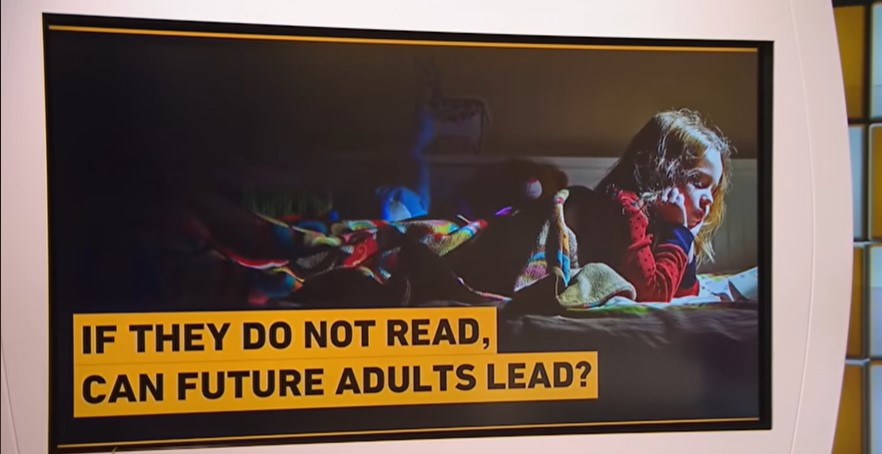
Recent data reveals a troubling decline in reading skills. In the United States, 54 percent of adults read below a sixth-grade level. This means more than half struggle with texts written for a 12-year-old. Among adolescents, roughly one-third of 13- to 14-year-olds demonstrate below-basic reading proficiency.
The consequences extend beyond academics. Many high school students graduate without reading a complete book independently. Educators also report developmental issues such as weak pencil grip and limited core strength, which often correlate with reduced fine motor practice and limited early literacy engagement.
Functional illiteracy affects daily life. Basic grammar distinctions such as “your” versus “you’re” or “to” versus “too” may appear minor. However, persistent confusion signals deeper comprehension gaps. Reading remains foundational for critical thinking, academic success and long-term opportunity.
Why Parent-Child Reading Shapes Brain Development
Early childhood represents a critical window for literacy development. During the first three to five years, the brain forms neural pathways rapidly. Shared reading between caregivers and children strengthens vocabulary, comprehension and emotional connection.
When parents read aloud, they do more than introduce stories. They build attachment and curiosity. Children associate reading with safety and pleasure. This positive association motivates sustained engagement later in life.
Research shows that children who enter school with strong oral language skills adapt more easily to formal reading instruction. By contrast, limited early exposure to books often results in weaker vocabulary and slower decoding progress.
Parent-child reading does not require long sessions. Even short daily routines reinforce neural development and create a culture of literacy at home.
The Impact of Ineffective Teaching Methods
In the 1990s, many schools adopted a method known as three-cueing. This approach encouraged students to guess words based on pictures, context or memory instead of decoding letter sounds systematically.
While this method appeared effective in early grades, it often failed when texts became more complex. Students who relied on guessing struggled in third grade and beyond. Many states have since moved away from this approach in favor of structured phonics-based instruction.
The science of reading draws on nearly a century of research in cognitive psychology and neuroscience. It demonstrates that reading requires explicit teaching of sound-letter relationships. Unlike spoken language, reading does not develop naturally without structured guidance for most learners.
When decoding skills remain weak, comprehension declines. Over time, academic gaps widen and confidence erodes.
How Reading Skills Develop
Literacy grows in stages. First, children learn to decode words by connecting sounds and letters. Next, they extract meaning from individual sentences. Then, they connect ideas across paragraphs, identifying themes and logical progression. Finally, they integrate new information with prior knowledge to analyze critically.
Breakdowns often occur at the decoding stage. If foundational skills remain fragile, higher-level comprehension suffers. However, evidence-based reforms demonstrate improvement is possible. For example, Mississippi significantly improved its reading rankings after implementing science-based curricula and teacher training.
Strong instruction builds upon early home engagement. When connection and structure align, literacy outcomes improve dramatically.
Adult Literacy and the Influence of Screens
The literacy challenge does not end with childhood. Surveys indicate that 40 percent of adults did not finish a single book in 2025. Although digital access has expanded, screen-based consumption often fragments attention.
Long-form reading encourages sustained focus and deeper cognitive processing. It also builds background knowledge necessary for evaluating information critically. In an era of misinformation and viral content, the ability to assess credibility depends heavily on reading proficiency.
Adults serve as primary literacy models for children. When parents prioritize screens over conversation and reading, vocabulary exposure declines. Bookshelves, shared stories and intentional dialogue signal that literacy matters.
Classroom Realities and the Role of Joy
Teachers observe a widening gap between proficient readers and struggling students. Some children arrive at school with strong oral language foundations. Others lack exposure to sustained conversation or storytelling.
Post-pandemic attendance disruptions and behavioral challenges further complicate instruction. However, when classrooms create interactive reading environments, enthusiasm grows. Students who experience structured success often develop intrinsic motivation.
Children enjoy activities at which they feel competent. Therefore, effective instruction combined with positive reinforcement builds both skill and confidence.
The Long-Term Consequences of Illiteracy
Literacy influences economic mobility and civic engagement. Individuals with limited reading skills face barriers to stable employment and higher education. Over time, disparities widen between strong readers and those who struggle.
Low literacy also affects public discourse. When individuals cannot evaluate information critically, polarization and misinformation spread more easily. The cost of neglect appears later in unemployment, social instability and reduced opportunity.
Early intervention remains more effective and less costly than remediation in adulthood.
Evidence-Based Solutions
Encouragingly, improvement is achievable. States that adopt structured literacy programs grounded in research demonstrate measurable gains. Implementation, however, requires commitment from policymakers, educators and families.
Parents can begin immediately by reading aloud daily, even briefly. Teachers benefit from professional development aligned with cognitive science. Schools should prioritize comprehension and reasoning rather than narrow test preparation.
Connection and instruction must coexist. Emotional bonding builds motivation. Explicit teaching builds skill.
Practical Guidance for Families and Educators
Reduce screen time and increase direct interaction. Engage children in conversation. Read aloud consistently. Discuss stories and ask questions that encourage reflection.
Recognize that while a small percentage of children learn to read naturally, most require structured support. Small-group instruction and individualized attention can accelerate progress.
Reading remains the gateway skill. It supports every academic subject and underpins lifelong learning. Addressing literacy now strengthens future generations and reduces long-term societal costs.
MORE STORIES:
 Good News! Pi Network: The Only Cryptocurrency Endorsed by Governments Worldwide – The Future of Digital Finance Starts Here
 Vietnamese Media Calls on Public to Embrace Digital Currency Movement, Spotlighting Pi Network
 Job opportunities: Apply for Human Resource and Administration Ecoplanet Bamboo Rwanda Ltd
Job opportunities: Apply for Agriculture And SME Development Project Officer
Job opportunities: Apply for Manager Job
Job opportunities: Apply for Human Resource and Administration Ecoplanet Bamboo Rwanda Ltd
Job opportunities: Apply for Agriculture And SME Development Project Officer
Job opportunities: Apply for Manager Job
 Bitcoin Surpasses Amazon to Become the Fifth Largest Asset by Market Cap
 Some Resist the Rise of AI, Citing Environmental Concerns and a Loss of Human Connection
 AI Won’t Replace Humans; But Humans With AI Will Replace Humans Without AI
 Rwanda’s New Policy to Combat Online Scams
 The Rwandan digital ID will be issued to citizens, refugees, and foreign residents