




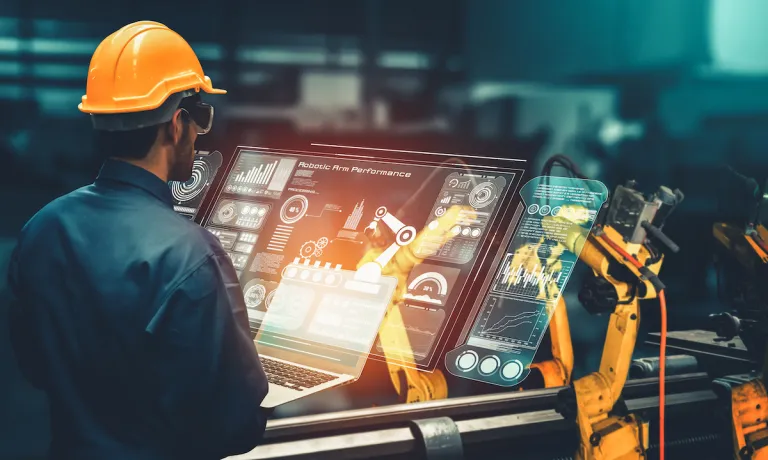
Artificial intelligence continues to expand beyond digital services and into industrial operations. Bob McGrew, the former chief research officer at OpenAI, is now leading a new startup focused on bringing AI technology into manufacturing environments.
The company, called Arda, is currently raising around 70 million dollars in funding at an estimated valuation of 700 million dollars. The startup aims to build a platform that connects artificial intelligence systems with real world factory operations.
Arda’s name draws inspiration from the fictional world created by author J.R.R. Tolkien. In this context, the name reflects the company’s ambition to link the digital intelligence of AI with the physical systems that power manufacturing industries.
AI Systems Designed for Factory Operations
Arda is developing a software platform that uses artificial intelligence to analyze factory operations. One of the company’s key tools includes a video analysis model that studies footage from production environments.
The system uses this data to train robots and automation systems to perform industrial tasks more effectively. By learning directly from real factory environments, the technology aims to improve how machines interact with equipment, workers, and production workflows.
The platform also intends to coordinate multiple parts of the manufacturing process. This includes supporting product design, evaluating manufacturability, and managing production lines until final goods reach completion.
McGrew’s previous work at OpenAI involved training robots to interact with the physical world. That experience now informs the development of Arda’s industrial AI solutions.
A Growing Trend Among Former AI Leaders
Bob McGrew is not the only former OpenAI executive launching a new artificial intelligence company. Several former leaders from the organization have started their own ventures in recent years.
Mira Murati, previously the company’s chief technology officer, launched an AI startup called Thinking Machines in 2025. Meanwhile, OpenAI co founder Ilya Sutskever introduced a new research company called Safe Superintelligence in 2024.
These ventures reflect growing interest in applying advanced AI systems to new industries beyond software platforms and consumer applications.
Challenges in Integrating AI Into Manufacturing
Despite the potential benefits, integrating AI into manufacturing remains complex. Research from the Massachusetts Institute of Technology suggests that early AI deployments in factories often improve existing processes rather than transform them completely.
Many companies use AI tools for predictive maintenance, visual inspection of products, or demand forecasting. However, these tools often operate alongside traditional production systems rather than replacing them.
Manufacturing environments depend on tightly coordinated operations, including supply chain coordination, equipment scheduling, and legacy industrial systems. Without careful integration, AI tools can create additional complexity rather than improving efficiency.
Organizational Change Is Key to Productivity Gains
Researchers emphasize that productivity improvements appear when companies combine AI adoption with organizational changes. Businesses must redesign workflows, standardize data systems, and train employees to work effectively with intelligent tools.
Experts describe this process as part of a “J curve” effect. During the early stages of adoption, companies may experience temporary productivity declines while adjusting to new systems. However, once organizations adapt, they often achieve stronger long term growth.
Future Outlook for Industrial AI
Startups such as Arda highlight a growing focus on industrial artificial intelligence. As factories become more connected and data driven, AI platforms could help companies optimize production, reduce downtime, and improve supply chain coordination.
However, the success of these technologies will depend on how effectively companies integrate them with existing systems and workforce capabilities.
If these challenges are addressed, industrial AI platforms may become a central component of the next generation of smart manufacturing systems.
This article is for informational purposes only and does not constitute financial advice. Consult a qualified professional before making financial decisions.
MORE STORIES:
 Hidden Workers Behind AI: The Data Labelers’ World
 Google I/O 2026: Everything We Expect From Google’s Biggest AI and Android Event
 Mount Kigali University Unveils Humanoid Robot for AI Education
 Macron India Visit Centers Africa AI Partnership
 Intron Expands Sahara AI Speech Platform to 57 Languages
 Samsung AI Factory Strategy Transforms Supply Chain Automation
 AI Becomes Daily Habit as Consumers Shift From Search to Chatbots
 Rwanda Seeks Re Election to ITU Council
 How AI Tools Work and How to Use Them Effectively
 Rwanda Government and Anthropic Sign AI Agreement
I will right away clutch your rss feed as I can’t to find your e-mail subscription link or newsletter service. Do you’ve any? Kindly permit me understand so that I could subscribe. Thanks.