






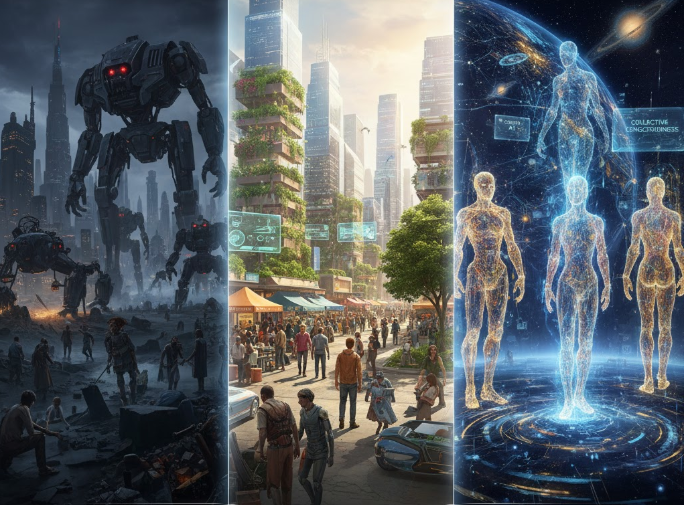
Artificial intelligence has reached a defining moment. According to technology strategist Alvin W. Graylin, humanity now stands at a crossroads. The direction AI takes will depend not on technical capability alone, but on how governments, companies and institutions manage critical resources such as compute power, advanced chips, data and expert talent.
The choices made today could shape global power structures, economic systems and social stability for generations.
A Future of Concentrated Power
One possible outcome is the rise of a trillionaire oligarchy. In this scenario, a small number of dominant AI laboratories consolidate control over the most powerful systems. By securing access to compute infrastructure and influencing regulation, these actors scale proprietary Artificial General Intelligence models capable of replacing average human productivity.
Such concentration could generate immense wealth for a few while deepening inequality for many. If companies frame AI as an existential race requiring deregulation and rapid expansion, they may secure political support while sidelining broader societal concerns. Over time, economic power could concentrate in unprecedented ways.
A Future of Escalating Conflict
A second possibility is geopolitical instability. Nations increasingly treat AI as a strategic asset linked to military, economic and technological dominance. Policymakers often frame development as a race for supremacy, particularly between major global powers.
If this rivalry intensifies, AI competition could extend into cyber warfare, economic disruption and military escalation. History shows that zero-sum competition in transformative technologies often increases mistrust. Without international coordination, the pursuit of technological leadership could fuel instability rather than innovation.
A Future of Shared Advancement
The third path offers a more optimistic vision. In this scenario, countries collaborate to pool resources, data and research expertise. Instead of duplicating efforts across hundreds of isolated laboratories, a global AI initiative could accelerate breakthroughs in medicine, energy, agriculture and climate resilience.
Open scientific collaboration has historically driven rapid progress. Institutions such as CERN and the International Space Station demonstrate how shared infrastructure can reduce duplication and expand discovery. Applying similar principles to AI development could unlock collective benefits while balancing cultural perspectives and reducing bias.

This cooperative model reflects a positive-sum mindset. When innovation serves global prosperity rather than narrow competition, society captures exponential returns.
Rethinking the AI Race Narrative
Public discourse often frames AI development as an urgent race, particularly between the United States and China. Graylin challenges this narrative. He argues that portraying AI as a winner-takes-all contest can justify rapid scaling without adequate safeguards.
If AGI systems automate average human labor, the impact on employment could be profound. Previous industrial revolutions unfolded over decades, allowing gradual adaptation. AI transformation may compress disruption into five to ten years. Without preparation, mass displacement could strain economic and social systems.
Addressing workforce transition becomes essential. The conversation must move beyond speed and supremacy toward sustainability and inclusion.
A Three-Part Strategy for Stability
Graylin proposes a structured approach to steer AI toward a cooperative future.
First, he calls for a global AI laboratory modeled on international research institutions. Pooling compute infrastructure, funding and expertise would reduce duplication and minimize competitive waste.
Second, he advocates for global data integration. AI models trained only on narrow national datasets risk bias and incomplete understanding. Diverse, multilingual and multicultural data would improve fairness and accuracy.
Third, he suggests a modern equivalent of the GI Bill for the AI age. After World War II, educational and housing support programs strengthened the middle class and stabilized society. Large-scale retraining initiatives could help workers adapt to automation and maintain economic resilience.
Together, these measures align with enlightened self-interest. Cooperation reduces incentives for conflict and expands shared opportunity.
The Role of Businesses and Individuals
Organizations must also rethink how they deploy AI. Rather than focusing solely on cost reduction through layoffs, leaders can use AI to augment productivity while investing in reskilling. Shorter workweeks, structured retraining programs and gradual workforce transitions can mitigate disruption.
Individuals benefit from engaging directly with AI tools. Regular experimentation builds literacy and prepares workers for evolving roles. Avoiding the technology increases vulnerability to change.
Public advocacy matters as well. Encouraging responsible governance, ethical deployment and collaborative frameworks influences policy direction.
The Choice Ahead
AI’s trajectory is not predetermined. Concentrated power, geopolitical rivalry or shared prosperity remain possible outcomes. The path society chooses will shape economic opportunity, social cohesion and global stability.
The defining question is not whether AI will advance. It is whether humanity will guide that advancement toward competition or cooperation.
Related posts:
 Google Reports Surge in AI-Driven Cyberattacks by State Hackers
 ChatGPT’s Future: A New ‘Super Assistant’
 Securing AI Agents: A Car-Driving Analogy for Governance
 How People Are Making Money Using Artificial Intelligence
 Tech Leaders Recognized for Shaping Modern AI
 Artificial Intelligence in Rwanda: How It Is Transforming Everyday Life
 Nigeria Set to Pass Landmark AI Law
 Africa and the AI Race: Analyzing Competitiveness
 AI-Driven Cyber Espionage Targets Russian Defense Firms
 The Rise of AI for Everyone: Practical Benefits and Tools for Non-Tech Users
 AI-Powered Training Initiative Transforms Public Service
 How Google aims to teach AI Africa’s 2,000 languages
 Struggling Doesn’t Make You Smarter. Using AI Does
 Can artificial intelligence ever love a human?
 Google and PayPal Team Up for AI-Driven Payments
 Modern technology to secure privacy of users
 Perplexity AI Offers $34.5B to Buy Google’s Chrome Browser
 Nvidia Unveils Self-Driving Car Tech as AI Expansion Accelerates
 EU Opens New Investigation Into X and Grok AI Tool
 OpenAI Launches ChatGPT Health to Analyze Medical Data