





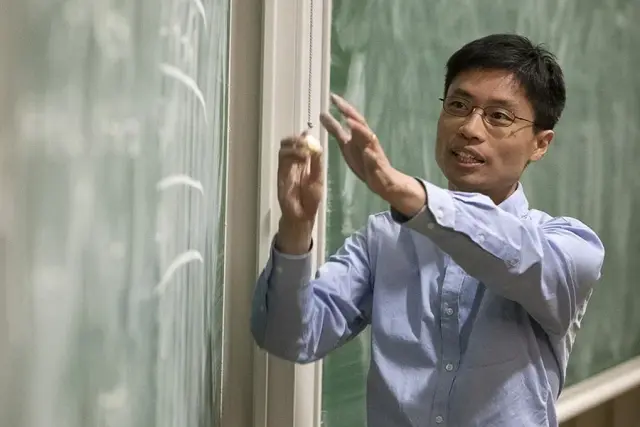
Artificial intelligence is transforming global economies, yet one of the most overlooked resources may be human talent in rural and low-income communities. Mathematician Po-Shen Loh argues that extraordinary cognitive ability exists far beyond elite urban centers. The challenge is not intelligence. It is visibility and connection.
During visits to high-poverty rural schools in South Carolina, Loh observed remarkable pattern recognition skills among fourth-grade students. When presented with the sequence 1 + 3 + 5 + 7 + 9, students quickly responded with 25. They instinctively recognized that the sum of the first five odd numbers equals five squared.
These children had limited access to phones or internet. Instead, they invented their own games, strengthening reasoning skills through curiosity. Without constant digital distraction, they practiced flexible thinking naturally.
Similar experiences emerged in parts of Africa. Capable individuals demonstrated strong analytical potential, yet global systems rarely noticed them. External aid often targets institutions rather than identifying talented individuals directly. The result is a visibility gap, not a talent gap.
Building High-Trust Global Coaching Networks
To bridge this divide, Loh developed cross-border coaching systems. High school students from countries such as the United States, Korea and China mentor middle school students in underserved regions, including Rwanda and Ethiopia.
The model prioritizes trust and real interaction. Coaches are selected not only for academic ability but also for empathy and adaptability. Through direct collaboration, both sides recognize each other’s strengths.
Over time, these connections can generate economic opportunity. Within five to ten years, such networks may enable remote hiring, shared entrepreneurship and cross-border partnerships. Wage differences can become mutually beneficial through distributed collaboration.
In the AI era, high-trust networks may matter more than institutional pedigree.
AI’s Disruption and Human Differentiation
AI now performs tasks once reserved for specialists. Advanced systems solve mathematics problems, generate software code and assist in technical design. Even software engineering roles increasingly involve managing AI agents rather than writing every line of code manually.
Robotics also expands into physical labor. Automation affects both white-collar and blue-collar roles.
However, AI lacks authentic human intention. People can detect sincerity, ethical concern and big-picture awareness in face-to-face interaction. These qualities remain difficult to replicate.
Future hiring may shift toward individuals who demonstrate adaptability, integrity and learning capacity rather than narrow specialization.
The Need for Human Oversight
As automation expands, risks multiply. Highly interconnected systems increase vulnerability to error or misuse. Therefore, trustworthy human oversight becomes more valuable.
Reliable individuals who understand systems and care about societal impact will play key roles in maintaining safety and accountability.
Motivation in the Post-AI Economy
AI democratizes access to knowledge. Students can request explanations instantly. However, traditional motivators such as exam rankings leading to stable careers weaken in uncertain labor markets.
Purpose-driven learning becomes essential. When students focus on solving meaningful problems and helping others, curiosity becomes self-sustaining. Networks of thoughtful peers reinforce motivation more effectively than rigid hierarchies.
Practical Advice for the AI Era
Several strategies stand out for long-term success:
- Develop strong communication skills, especially fluent English, to access global systems.
- Demonstrate genuine care and reliability to build trust within networks.
- Practice non-standard thinking by tackling unfamiliar problems creatively.
- Accept instability as part of technological transformation and remain flexible.
Untapped talent exists worldwide. The future may favor those who combine curiosity, trustworthiness and global connection rather than those who simply follow predefined career ladders.
Related posts:
 US Immigration Agent Fatally Shoots Woman in Minneapolis
 The Rwandan digital ID will be issued to citizens, refugees, and foreign residents
 China Accuses U.S. of Long-Term Cyberattacks on National Time Agency
 Heart Diseases Can Be Prevented
 Airbus Surpasses Boeing in Passenger Aircraft Sales
 Gaza: Over 250,000 People Return Home Since Ceasefire Began
 Rwanda Parliament Passes New Road Traffic Law
 Former Prince Andrew faces new allegation linked to Epstein
 The Evolution of Patriotism in Rwanda: A Legacy that Shapes Generations
 North Korea Unveils Hwasong20, Its Most Powerful Missile Yet
 Rwanda Moves to Establish a Social Protection System for Informal Workers
 Trump Appoints Dan Scavino to Lead White House Personnel Office, Names Sergio Gor Ambassador to India
 French Military Evacuates Madagascar’s President Rajoelina Amid Escalating Unrest
 Leaked Documents Allege Biden Family Involvement in Corruption Scandal in Ukraine
 Boris Johnson Calls for Revival of Rwanda Deportation Plan Over Digital ID Scheme
 Fred Gisa Rwigema: A Hero’s Sacrifice for Rwanda’s Peace
 The Myth of “Hard Work Pays”: Why Effort Alone Isn’t Enough
 Israel Says Gaza War Won’t End Until Hamas Is Disarmed
 President Samia Vows to Confront Those Intimidating Tanzanian Voters
 Israel Defies Trump’s Call, Kills 50 People in Gaza