


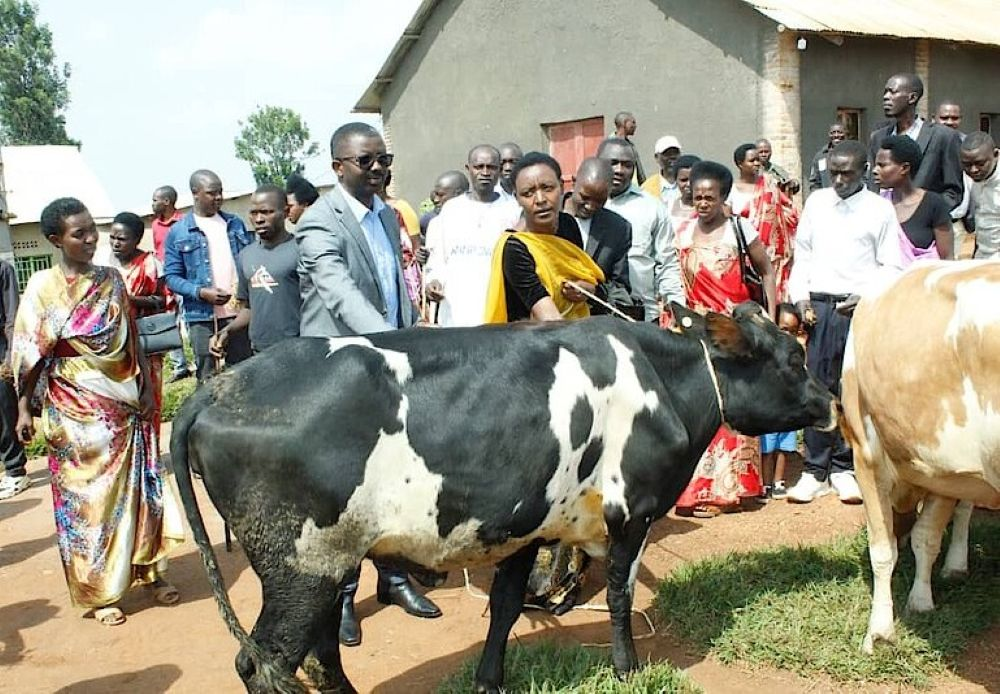
Gisagara District has distributed more than 36,800 cows to residents, mainly vulnerable families, over the past five years under the One Cow per Family Program, local authorities have confirmed.
The initiative, which began in 2020, complements the national Girinka Munyarwanda Program and aims to improve nutrition, boost household incomes, and reduce poverty among rural families. Agriculture remains the main source of livelihood in Gisagara, where over 86 percent of residents depend on farming.
Supporting Vulnerable Families
District officials say the program prioritizes low-income households to help them build sustainable livelihoods. Cows are provided to families who previously lacked livestock, enabling them to access milk, organic fertilizer, and additional income.
Local leaders describe the program as a key pillar of social protection and economic development, especially for families struggling with malnutrition and food insecurity.
Beneficiaries Share Their Experiences
Jean Damascène Bizumuremyi, a resident of Kibilizi Sector, recently received a cow shortly after his wife gave birth to twins. He says the cow marks a turning point for his family.
“Receiving a cow means milk for my children and better nutrition,” he said. “It also provides manure for farming, which will help us grow more food and secure our future.”
Another beneficiary, Jean Baptiste Nzabamwita, said the cow will improve both household food production and income.
“This cow helps me get manure, feed my family, and sell surplus produce,” he explained. “When I pass on a calf to another family, it will strengthen unity and solidarity in our community.”
Boosting Nutrition and Agricultural Productivity
The Deputy Mayor of Gisagara District in charge of Economic Development, Jean Paul Habineza, said the program plays a vital role in fighting poverty and malnutrition.
He emphasized that cows are more than livestock, describing them as a source of multiple economic benefits.
“This program has addressed the shortage of organic fertilizer, increased milk production, improved nutrition, and boosted household incomes,” Habineza said. “It also promotes social cohesion through the tradition of sharing calves.”
Significant Growth in Livestock Ownership
Since the launch of the district-level cow distribution program in August 2020, cattle ownership in Gisagara has risen from 30 percent to 71 percent, accelerating the implementation of the national Girinka initiative.
Authorities attribute this progress to partnerships with cooperatives, non-governmental organizations, faith-based groups, and the practice of passing on calves to new beneficiaries.
Looking Ahead
Currently, Gisagara District is home to over 63,700 cows, and officials say efforts will continue to increase this number in line with the broader Girinka Munyarwanda Program, launched nationally in 2006 by President Paul Kagame.
District leaders believe expanding livestock ownership will further improve food security, household income, and community resilience, ensuring long-term economic growth for residents.
MORE STORIES:
 Transcending the Transition: Pi Network’s Quiet Evolution Toward a New Digital Economy
 China’s 16-Ton Jiutian Drone Completes Historic First Flight
 Six Major Technology Events Coming to Kigali in 2026
 Update: ACADEMIC CALENDAR FOR THE ACADEMIC YEAR 2025/2026
 Apply for ENUMERATORS job at ADEPE
 Trump gives Hamas deadline to accept Gaza peace plan
 Trump Appoints Dan Scavino to Lead White House Personnel Office, Names Sergio Gor Ambassador to India
 Job Opportunities at Green Hills Academy
 Job opportunities at RwandaAir
 Global PiGCV X Summit Brings Together International Leaders to Advance Pi Payments and Scarcity Principles
Bạn có thể đặt lịch chơi tự động tại Sơ đồ trang web XML – XN88 Game – ví dụ: mỗi tối 8h, hệ thống nhắc bạn vào chơi slot yêu thích – tạo thói quen giải trí lành mạnh. TONY03-18H