






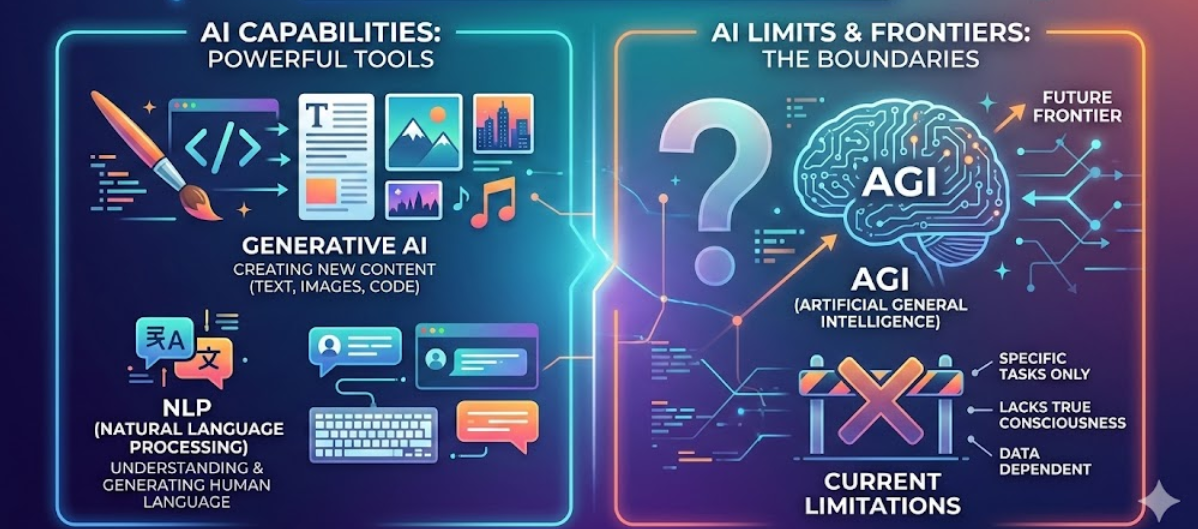
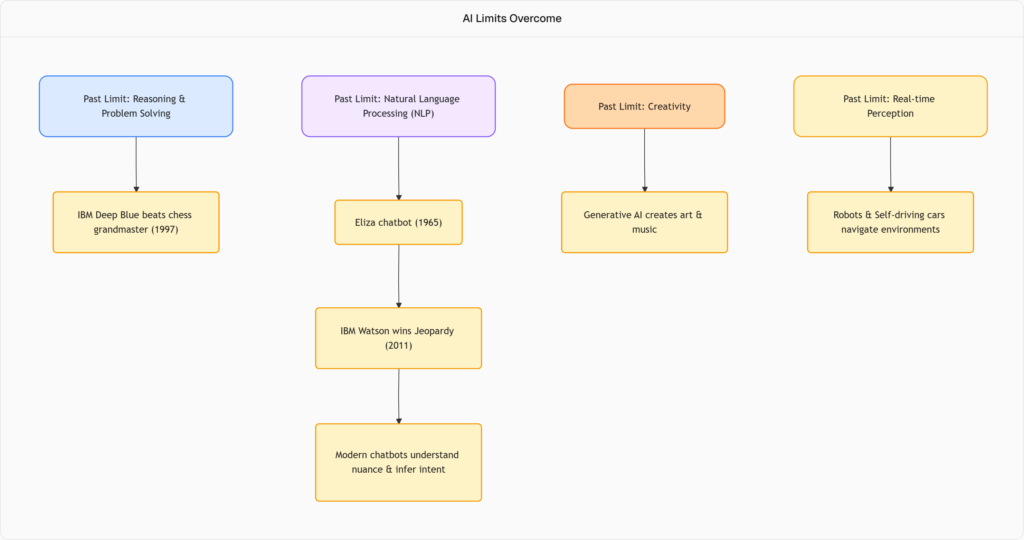
Artificial intelligence is advancing at extraordinary speed. It writes reports, generates images, builds software, summarizes research and powers global digital systems. Yet despite these breakthroughs, important limits remain.
Understanding what AI can and cannot do is essential. Without clarity, hype replaces strategy. This article explains the real capabilities of generative AI, natural language processing, and the ongoing pursuit of Artificial General Intelligence.
Generative AI: Impressive but Predictive
Generative AI systems create text, code, images and even music. However, their mechanism is mathematical, not conscious. These systems predict patterns based on vast training data. They do not reason in the human sense.
Because of this structure, generative AI can sometimes produce incorrect answers with high confidence. This issue, often called hallucination, results from statistical prediction rather than intentional deception.
To reduce this risk, researchers use:
- Retrieval Augmented Generation to connect responses to verified data sources
- Mixture of Experts models to route tasks to specialized systems
- Chained reasoning models to verify outputs step by step
These advances improve reliability. However, they do not create understanding. They refine prediction.
NLP: Language Fluency Without Experience
Natural Language Processing enables machines to interpret and generate human language. Modern systems can detect tone, simulate empathy and adapt conversational style.
Nevertheless, language simulation is not emotional awareness. AI systems do not feel joy, grief or pride. They identify patterns associated with those emotions in data.
Therefore, while NLP systems appear conversationally intelligent, they operate through correlation rather than lived experience.
AGI: Still a Theoretical Frontier
Artificial General Intelligence represents a system capable of human-level reasoning across domains. Unlike today’s specialized AI tools, AGI would transfer knowledge, adapt autonomously and operate flexibly in unfamiliar environments.
Current AI remains narrow. It performs exceptionally within defined boundaries but lacks:
- Cross-domain reasoning
- Self-directed macro goal formation
- Independent ethical judgment
- Integrated physical-world understanding
AGI remains a research objective, not a present reality.
The DIKW Gap: From Data to Wisdom
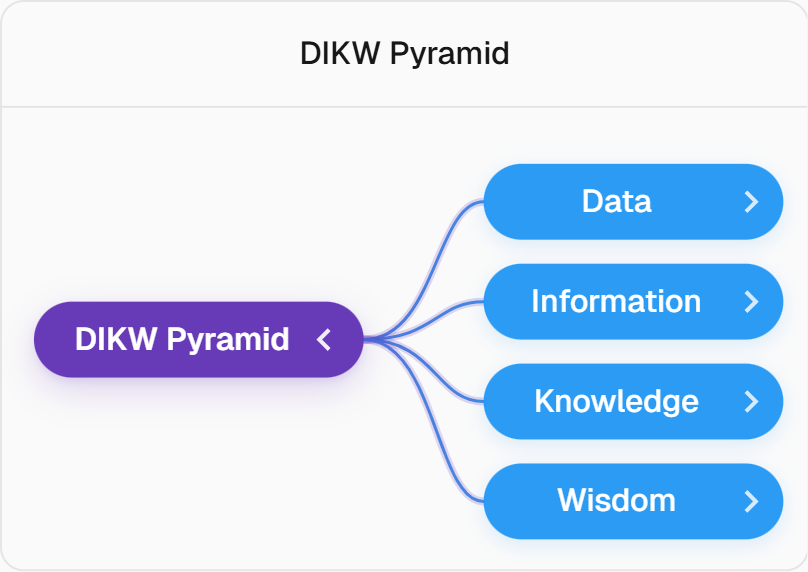
The DIKW framework helps clarify AI’s limits:
- Data represents raw facts
- Information organizes those facts
- Knowledge applies them contextually
- Wisdom requires ethical and long-term judgment
AI excels at transforming data into information. It increasingly supports knowledge-level applications. However, wisdom remains a human domain because it involves values, moral reasoning and purpose.
This distinction is crucial. Intelligence alone does not equal wisdom.
Structural Constraints: Energy and Sustainability
Another limit is practical. Large AI systems require significant computational resources, electricity and cooling infrastructure. As adoption expands, efficiency becomes a central challenge.
Future AI progress will likely focus on optimized, right-sized models rather than endless scaling.
Where Humans Remain Essential
AI agents can execute tasks rapidly once given an objective. However, defining purpose remains a human responsibility.
Humans determine:
- What problems matter
- Why solutions are needed
- Which ethical boundaries must guide decisions
AI determines how to optimize within those parameters.
This complementary structure defines the future of AI integration.
What Comes Next?
The next phase of AI development will likely emphasize:
- Greater grounding in verified knowledge
- More reliable multimodal systems
- Deeper enterprise integration
- Improved human-AI collaboration
However, true autonomy with wisdom and self-awareness remains unresolved.
The most realistic future is not human replacement. It is human augmentation.
AI enhances execution. Humans define direction.
Related posts:
 Global pressure forces xAI to limit Grok image features
 AI Models Refuse Shutdown, Raising Concerns
 AI Companies Will Fail — What Society Can Salvage From the Wreckage
 Governments Push for Responsible AI Laws
 AI Alarmism Surges in Early 2026 as Risks and Pace Collide
 OpenAI Explores Spacecraft Project
 AI and Drones Could Help African Projects Secure Investment Faster
 Using AI In a Right Way : A Quick Guide
 Macron India Visit Centers Africa AI Partnership
 Rwanda Government and Anthropic Sign AI Agreement
 NVIDIA helps Germany lead Europe’s AI manufacturing race
 Is AI going to conqure Whole world?
 AI Tools for Students Explained: A Simple Guide
 Meta AI Chief Says Current Models Lack Intelligence
 How Artificial Intelligence Is Transforming Rwanda’s Economy
 Governments Condemn Grok Over AI-Generated Sexualized Images
 AI Sparks Debate on Human Creativity
 Google Reports Surge in AI-Driven Cyberattacks by State Hackers
 Hidden Workers Behind AI: The Data Labelers’ World
 10 Incredible Examples of AI in Everyday Life