




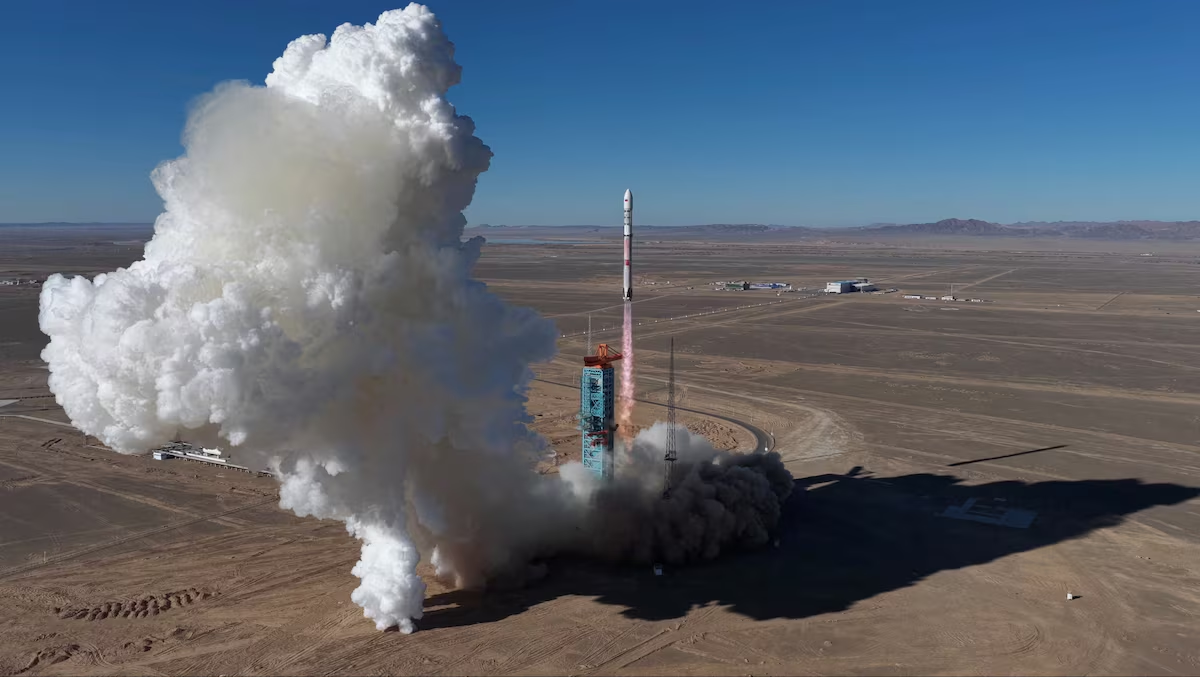
Earlier this month, LandSpace made history by becoming the first Chinese company to conduct a full reusable rocket test. Its Zhuque-3 rocket lifted off on its maiden flight from a remote site in northwest China, drawing comparisons with SpaceX’s Falcon 9.
Although the mission did not achieve the final goal of landing and recovering the booster, it marked a significant step forward for China’s commercial space sector.
ALSO READ: Airbus Plans to Stop Using Google Cloud Over Data Security Concerns
Second Test Flight Planned
LandSpace plans to attempt booster recovery again in a second Zhuque-3 test flight in mid-2026, said deputy chief designer Dong Kai during an interview with the Chinese podcast Tech Early Know.
“If recovery succeeds on the second flight, we plan to use a previously flown first stage on the fourth launch,” Dong explained.
SpaceX Remains the Global Leader
Currently, SpaceX is the only company that has fully mastered reusable rocket operations. Its Falcon 9 rocket launches about 150 times per year, with individual boosters reused dozens of times.
Elon Musk acknowledged in October that Zhuque-3’s design has strong potential, but noted that it would take LandSpace more than five years to match Falcon 9’s launch frequency. By then, SpaceX expects to rely primarily on its next-generation Starship system, capable of delivering vastly greater payloads.
Challenges of Launch Frequency in China
Dong expressed skepticism that Falcon 9’s pace could be exceeded anytime soon, pointing out that all Chinese rocket launches combined this year total roughly 100 missions.
“Reaching that level of frequency is extremely difficult for a single company,” he said, emphasizing the need for a strong national ecosystem. LandSpace currently plans 10 launches next year across its rocket models.
IPO Seen as Key to Future Growth
Company executives have previously noted that SpaceX’s success depends heavily on its ability to finance frequent testing and launches. For LandSpace, achieving a similar scale would likely require significant funding.
As a result, the company is preparing to tap China’s capital markets, with plans for an initial public offering (IPO) next year to support long-term development and innovation.
Related posts:
 iPhone 17 Pro: What You Need to Know about iPhone 17 Pro
 UGHE Launches Rwanda’s First HD²SS System
 Africa Rewrites Its Digital Narrative in the Modern Age
 Character.ai Yiyemeje Gukora Porogaramu za AI Zishobora Kuba Inshuti z’Abantu
 China Launches Advanced Satellite to Test High-Level Communications
 Samsung Launches Three-Panel TriFold Phone to dominate Apple and Huawei
 Rwanda Launches International Cybersecurity Training Center (Cyber Academy)
 How Do Social Media Algorithms Work?
 Rwanda Adopts Advanced Technology to Improve Disaster Communication Systems.
 WhatsApp Starts Testing AI Feature on Android Beta!
 Concerns About AI Technology That Could Surpass Human Intelligence
 Amazon to Build 12 Nuclear Energy Plants Similar to Those Planned in Rwanda
 Rwanda invests 300 billion Rwf in towers: A solution to Internet issues
 Google Not Required to Sell Chrome or Android, U.S. Court Rules
 SpaceX Provides Free Starlink Access During Natural Disasters
 4.3 Million Rwandans Have Gained Digital Literacy
 ChatGPT to Introduce Adult-Oriented Erotic Content
 Airbus Plans to Stop Using Google Cloud Over Data Security Concerns
 France Fines Google and Shein Over 800 Billion Rwandan Francs for Privacy Violations
 Flying Cars on the Way: XPeng’s Ambitious Roadmap Wins Over Investors