



The Spanish high-speed train crash has shocked the nation after two trains collided in southern Spain, killing at least 40 people and injuring more than 120. Prime Minister Pedro Sánchez has pledged to uncover the exact cause of the tragedy, promising full transparency as Spain enters three days of national mourning.
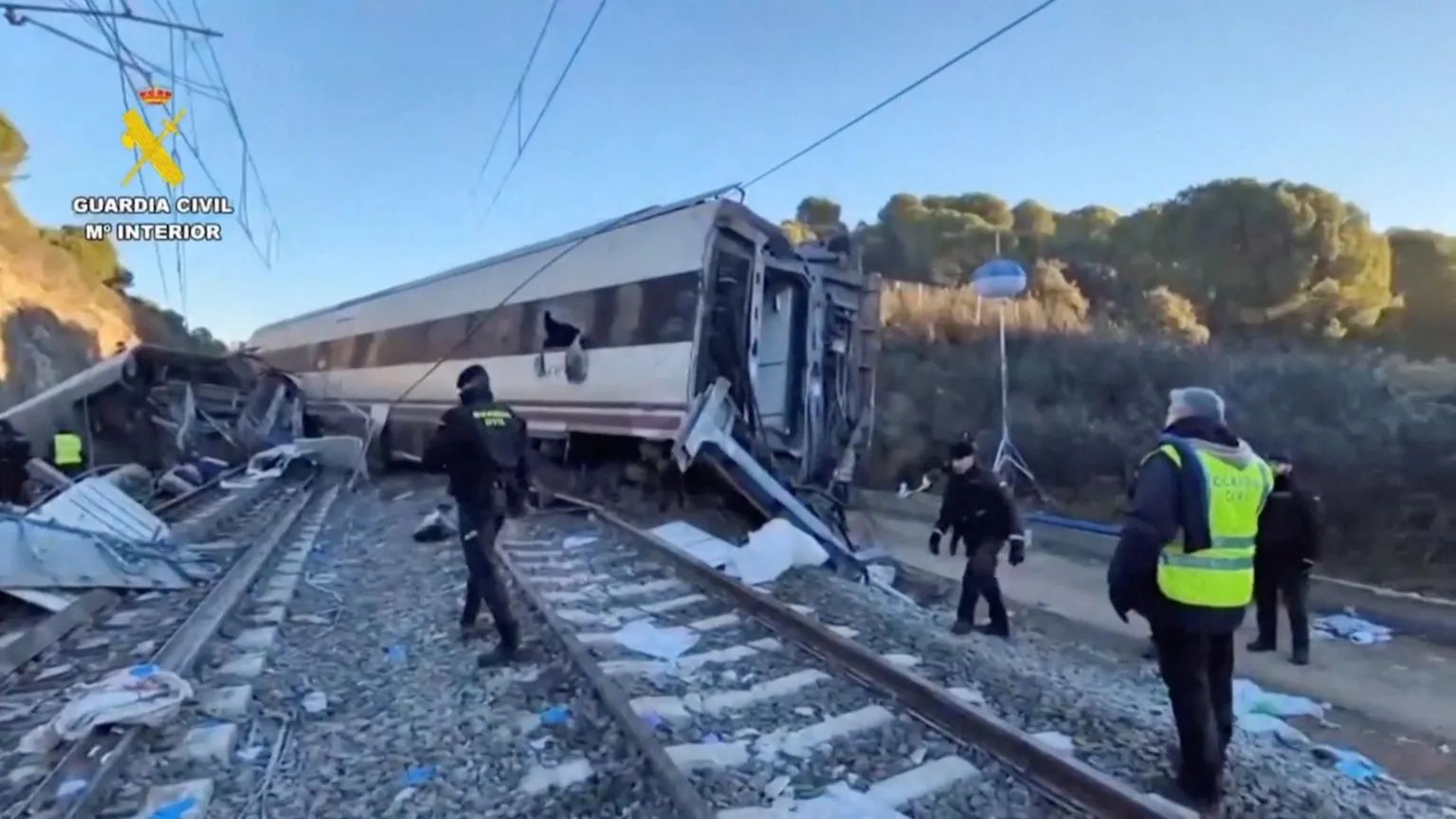
The collision occurred on Sunday evening near Adamuz, close to the city of Córdoba, when a Madrid-bound train derailed and crossed onto opposite tracks, striking an oncoming service.
Prime minister promises transparent investigation
After visiting the crash site, Sánchez addressed the nation, describing the incident as a moment of deep national grief.
“We are going to find the truth. We will make the causes public with absolute clarity,” Sánchez said.
Transport Minister Óscar Puente confirmed that investigators could take at least a month to determine responsibility, calling the circumstances “extremely strange.”
What happened on the tracks near Córdoba
Rail operator Adif said the crash happened at 19:45 local time, roughly one hour after the Málaga–Madrid train departed. The train derailed on a straight section of track before colliding with another high-speed service traveling from Madrid to Huelva.
Puente said the impact forced several carriages into an embankment, with most fatalities occurring in the front cars of the second train.
Early findings point to possible track fault
According to a source briefed on the preliminary investigation, experts discovered a faulty rail joint that may have widened under pressure as trains passed. Investigators are assessing whether the defect caused the derailment or resulted from the crash.
Spain’s El País reported that officials have not yet confirmed the fault as the definitive cause.
For background on rail safety standards, see Adif’s infrastructure oversight role and EU railway safety regulations (outbound links recommended).
Rescue efforts and survivor accounts
Emergency crews worked through twisted metal to reach trapped passengers. A total of 400 people, including staff, were aboard the two trains.
Journalist Salvador Jiménez, who survived the crash, said the impact felt like an earthquake.
“There was screaming everywhere. People called for doctors,” another passenger told Canal Sur.
As of Monday, 41 people remained hospitalized, including 12 in intensive care.
National mourning and service suspensions
King Felipe VI and Queen Letizia offered condolences, saying they followed the tragedy “with great concern.” Authorities suspended all high-speed rail services between Madrid and Málaga, Córdoba, Sevilla, and Huelva until Friday.
The Andalusian emergency agency urged survivors to contact relatives, while the Red Cross provided counseling to families.
Spain’s rail network under scrutiny
The crash marks Spain’s deadliest rail disaster in over a decade. In 2013, a derailment in Galicia killed 80 people. Spain operates Europe’s second-largest high-speed rail network, spanning more than 4,000 kilometers and connecting over 50 cities.
MORE STORIES:
 Leysdown beach manslaughter case: Teenagers guilty over killing of Alexander Cashford
 Iran State TV Hack: Hackers broadcast exiled crown prince Amid protests
 US Strikes Venezuela as Trump Claims Maduro Was Captured
 Trump Revives Plan to Bring Greenland Under U.S. Influence Amid Security Concerns
 Rwanda Among African Countries Set to Receive $40 Smartphones
 Life of Ugandan opposition leader Kizza Besigye in danger, wife warns
 Apple Raises MacBook Prices as Memory Shortage Intensifies
 US promises 15-year security guarantee to Ukraine amid peace talks
 Mount Kilimanjaro helicopter crash kills five during rescue mission
 The Return of Wired Headphones
Heey I know tthis iss off topic but I waas woneering iff yoou knnew off anyy
wiodgets I coud addd tto mmy blkg thgat automatically tweet mmy
nwest twitter updates. I’vebeen looking for a plug-in lie this foor quite
some time and wass hopinng mayhe yoou wwould havfe some experiennce
with somethingg like this. Pleasee lett me know iif yyou run ijto anything.
I truy enjoy resading your bllg andd I lookk forward tto yor new updates.
Tôi đánh giá cao phần hỗ trợ khách hàng ở đây vì phản hồi khá nhanh và giải đáp thắc mắc rất nhiệt tình xn88 đăng nhập TONY06-25