



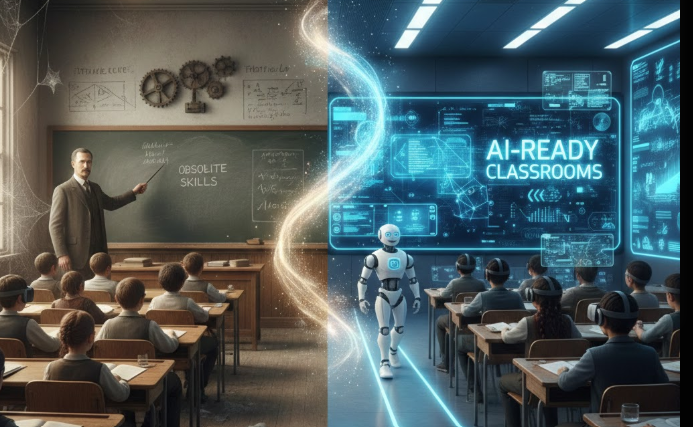
Education has always evolved alongside technology. When tools become more efficient than manual effort, schools shift focus. Skills once considered essential gradually lose priority.
In the past, schools treated cursive writing and penmanship as core subjects. Clear handwriting signaled discipline and professionalism. Today, most communication happens on digital devices. As a result, typing skills matter more than perfect handwriting.
The same shift occurred with memorization. Students once memorized the entire periodic table, including element names, positions and atomic numbers. Understanding chemical patterns remains important. However, memorizing every detail is less valuable when reliable databases provide instant access.
Complex arithmetic drills followed a similar path. Students practiced long division and multi-step calculations repeatedly. Now calculators handle advanced computation once students grasp core principles. Class time can focus on problem solving instead of repetition.
Map reading also lost prominence with the rise of GPS navigation. While basic orientation remains useful, daily travel depends on digital navigation tools. Limited classroom time forces educators to prioritize practical relevance.
These changes reflect a clear principle. Education must prepare students for real-world demands. Employers value technological fluency and analytical thinking more than outdated drills.
| Past Skill | Modern Tool | Reason for Shift |
|---|---|---|
| Cursive writing | Digital typing | Communication is computer-based |
| Periodic table memorization | Online databases | Concepts matter more than recall |
| Complex arithmetic drills | Calculators | Tools handle repetition |
| Traditional map reading | GPS navigation | Digital navigation dominates |
Future Skills in an AI-Driven Era
Artificial intelligence introduces a similar turning point. Schools must now emphasize human strengths that complement machine capabilities.
Adaptability stands at the center. Students need flexibility to adjust as AI reshapes industries. Creativity also grows in importance. When AI generates ideas quickly, humans must refine, expand and innovate beyond those suggestions.
Critical thinking remains essential. AI can produce inaccurate or biased results. Students must evaluate truth, relevance and ethical impact before applying AI-generated outputs.
AI can generate information, but humans must apply judgment. That distinction defines future competitiveness.
How AI Enhances Teaching and Learning
AI does not replace educators. It amplifies instruction.
Just-in-time learning allows students to receive instant explanations when confusion arises. Chatbots can refresh concepts quickly, saving time and increasing efficiency.
Personalized tutoring offers tailored explanations based on individual learning pace. Unlike crowded classrooms, AI tools provide repeated clarification without fatigue.
AI also functions as an advanced editor. It corrects grammar and explains writing rules, allowing teachers to focus on deeper content evaluation.
Accessibility improves significantly. AI tools convert text to speech, adapt content formats and support learners with disabilities.
Educators benefit as well. AI can assist with lesson planning, grading support and research preparation. This support frees instructors to concentrate on mentorship and higher-level teaching goals.
Cloud-based AI tools also promote equity. Students only need internet access and a browser to use advanced educational resources. This reduces disparities between well-funded and underfunded institutions.
| AI Application | Function | Educational Benefit |
|---|---|---|
| Just-in-time learning | Instant concept refresh | Efficient learning |
| Personalized tutoring | Adaptive explanations | Individual support |
| AI editing tools | Grammar and rule feedback | Teacher time savings |
| Accessibility tools | Format and speech conversion | Inclusive education |
| Teaching assistance | Planning and grading help | Focus on mentorship |
| Debate and practice tools | Argument generation | Stronger reasoning skills |
| Cloud access | Browser-based tools | Greater equity |
AI Literacy and Ethical Responsibility
Effective AI integration requires literacy. Students must understand what AI can do and where it fails. They should recognize bias, data limitations and reliability concerns.
Ethics also demands attention. Just because AI allows an action does not mean it should be taken. Responsible use includes considering unintended consequences and societal impact.
Combining technical awareness with ethical reasoning builds trust and safeguards long-term innovation.
Redesigning Assignments for Higher-Order Thinking
Educators can adjust assignments to emphasize skills AI cannot easily replicate.
Debates encourage spontaneous reasoning and communication. Students must defend arguments in real time. AI cannot replace that performance element.
Instead of memorization, teachers can focus on principles and applications. Understanding chemical patterns matters more than listing atomic numbers.
Rather than repetitive arithmetic drills, schools can prioritize algebra and calculus to strengthen reasoning skills. Essays still hold value, but assignments should measure analysis, synthesis and judgment.
Foundational knowledge remains critical. Students must master basics before relying on digital tools.
AI as a Permanent Educational Partner
AI is not temporary. It resembles the arrival of calculators or GPS systems. Future workplaces will expect employees to use AI effectively.
Education must prepare students to collaborate with AI tools ethically and strategically. Schools that resist adaptation risk irrelevance. Institutions that embrace thoughtful integration elevate learning standards and improve graduate readiness.
The goal is not replacement. The goal is intelligent partnership.
MORE STORIES:
 Pi Network Breaks $1: Your 2025 Guide to Mining Pi Coin Efficiently
 Rwanda Government and Anthropic Sign AI Agreement
 A Growing Literacy Crisis Among Children and Adults
 Spade Raises $40 Million to Expand Transaction Data Intelligence
 Job: Reconciliation Officer at ASA
 Digital Literacy in AI Era: Turning Technology’s Promise Into Power
 AI in Education: Promise, Pressure and the Search for Balance
Job: Apply for Customer Relations Assistant at old mutual limited
AI in Education: Promise, Pressure and the Search for Balance
Job: Apply for Customer Relations Assistant at old mutual limited
 Stripe Launches AI Usage Billing Tools for Software Companies
 An opportunities for Rwandan youth aged 18-25