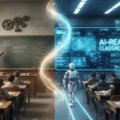





Artificial intelligence is transforming classrooms faster than many education systems can respond. Tools such as ChatGPT, Gemini and Claude can answer questions, generate essays, write code and act as virtual tutors. For many students, they make learning more accessible and personalized.
However, educators worry that constant reliance on AI may weaken creativity and critical thinking. Some critics even suggest that overdependence could erode core cognitive skills. This tension fuels a global debate: Is AI a breakthrough for learning or a threat to intellectual development?
The reality likely lies between these extremes.
Moving Beyond Bans and Blind Adoption
Professor Hani Farit, an AI researcher at Merkeley, argues that absolute positions fail in practice. Outright bans are difficult to enforce. Students find ways to use AI regardless of restrictions. At the same time, unlimited and unstructured use ignores real risks.
A balanced approach recognizes that AI should support learning, not replace it. In introductory courses, students may need to complete assignments independently to build foundational skills. In advanced courses, limited AI use can enhance research and exploration because students already understand core concepts.
This developmental model focuses on education’s main goal: teaching students how to learn. AI becomes a tool that complements effort rather than shortcuts it.
Estonia’s National AI Experiment
One of the most ambitious examples comes from Estonia, which introduced ChatGPT Edu nationwide for 10th and 11th graders. The education-specific version includes encryption and school-friendly controls. Unlike free versions, student interactions do not train public models.
At Mustamäe Gymnasium in Tallinn, teachers structure AI use carefully. In language classes, students first write independently. Then they use AI to correct grammar and refine structure. This sequence ensures that AI reinforces learning instead of replacing thinking.
Teachers emphasize digital literacy alongside academic skills. Students learn to verify information and avoid sharing sensitive data. However, educators note that awareness varies and requires constant reinforcement.
India’s Early Integration Strategy
In India, AI and computational thinking enter classrooms from the third grade onward. The country aims to prepare 250 million students for a digital economy.
The Chrysalis application helps teachers personalize instruction. Educators photograph student assignments, upload them and receive instant analysis. The system categorizes learners by proficiency level and suggests targeted activities.
In large classrooms where one teacher manages dozens of students, such tools offer scalable personalization. AI supports monitoring and feedback, especially in resource-constrained settings.
Teachers Under Pressure
Despite innovation, many teachers feel unprepared. Some use AI primarily to generate lesson plans. This saves time, but it does not replace pedagogical judgment.
Educational technologists stress that AI should enhance, not dictate, instruction. Teachers remain responsible for guiding discussion, cultivating curiosity and building context.
AI answers questions quickly. However, it cannot teach students how to navigate knowledge independently. That responsibility remains human.
The Rise of AI-Enabled Cheating
One of the most immediate concerns involves academic integrity. Universities report sharp increases in AI-related misconduct cases. Many students view AI-generated assignments as harmless shortcuts.
Yet educators observe qualitative differences. Essays often appear formulaic and less original. Over time, this pattern erodes trust between students and instructors. Teachers spend more time verifying authenticity instead of mentoring.
If students rely entirely on AI to complete tasks, they risk entering the workforce without essential analytical skills. Employers quickly recognize superficial understanding.
Productive Integration Models
To address misuse, schools experiment with assessment redesign. In-class exams, presentations, group discussions and project-based evaluations reduce reliance on take-home AI assistance.
The flipped classroom model offers another solution. Students watch instructional videos independently and use AI as a private tutor to clarify concepts. In class, they engage in discussion and applied problem-solving. In this framework, AI supports comprehension but does not replace collaboration.
Institutions such as Sapphire School invest in regular teacher training to ensure responsible use. Policymakers and researchers, including education expert Rebecca Winthrop, emphasize the need for clear guidelines and institutional support.
Preparing Students for an AI-Driven Future
AI tools will remain part of professional life. Avoiding them entirely does not prepare students for modern workplaces. Instead, education systems must teach students how to use AI critically and ethically.
When integrated thoughtfully, AI can reduce administrative burdens, expand access and personalize support. However, success depends on structured implementation and continuous training.
The future of learning will not be defined by AI alone. It will depend on how educators balance innovation with responsibility, ensuring that technology strengthens rather than diminishes human intelligence.