




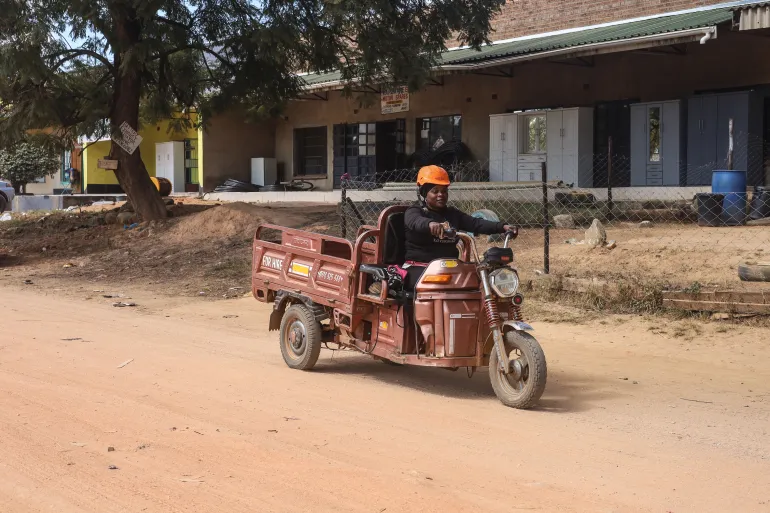
A police crackdown on electric tricycles in rural Zimbabwe is threatening the livelihoods of hundreds of women who depend on the vehicles for income and community transport services.
Many of the affected operators are single mothers and widows who use electric tricycles to transport goods, support their families, and provide essential services in remote areas.
One of them is Daires Mutamangira from Hauna in Manicaland Province. Last month, police stopped her while she was transporting a customer and groceries. Officers requested registration documents and a driver’s licence, which she did not have. She received an on-the-spot fine of $15.
Mutamangira said the experience was frightening and unexpected because she was operating on a rural path far from major highways.
E-Tricycles Become a Lifeline for Rural Communities
Electric tricycles were introduced to empower women and improve mobility in rural communities.
Mutamangira received her e-tricycle in May 2024 through a programme supported by Mobility for Africa, a local startup promoting sustainable transport solutions.
The vehicle can carry up to 450 kilograms of goods. This makes it valuable in farming communities where producers need affordable transportation for crops such as bananas, tomatoes, and onions.
In Hauna, located about 55 kilometres from Mutare, many farmers rely on the tricycles to move produce from farms to major roads where trucks transport goods to larger markets.
The vehicles also transport groceries, farming supplies, and passengers.
Mutamangira said the business once generated about $250 in monthly profit, allowing her to support her unemployed husband and provide for their four children.
Beyond business, the tricycles often serve as emergency transport for pregnant women and sick residents when ambulances are unavailable.
Police Enforcement Creates New Obstacles
The situation changed dramatically in early 2025 when police began enforcing regulations requiring operators to hold motorcycle licences and register their vehicles.
Zimbabwe currently classifies electric tricycles under the same legal category as motorcycles. As a result, operators must obtain licences, insurance, and registration permits.
Many women argue that these requirements fail to consider the unique role of low-speed electric tricycles in rural communities.
According to Mobility for Africa coordinator Sikhangezile Dube, police have impounded several vehicles and demanded compliance with existing laws.
When authorities seize a tricycle, owners must pay a $90 fine before recovering it.
The organisation submitted registration documents to relevant government agencies in June 2025. However, Dube said the process has seen little progress.
Income Losses Hit Families Hard
The crackdown has had severe financial consequences for many families.
Mutamangira said she struggled to pay school fees after authorities forced her to stop operating. Household spending had to be reduced significantly.
Instead of eating three meals per day, the family often survived on one meal.
Another operator, Rejoice Mandipedza, said debts quickly accumulated after her only source of income disappeared.
She explained that unpaid school fees and rental costs became major burdens during the shutdown.
Although some women resumed operations after a three-month break, police enforcement continued.
Many operators now hide their tricycles and only bring them out when customers require transport services.
As a result, monthly profits have fallen sharply. Several operators report earning only around $70 per month.
High Costs Remain Out of Reach
To operate legally, women must pay for a driver’s licence, vehicle registration, insurance, and licence fees.
The total cost approaches $500, an amount many rural operators cannot afford.
ALSO READ: Peabo Bryson, Legendary Disney and R&B Singer, Dies at 75
Mandipedza said saving enough money for compliance has become impossible because current earnings barely cover daily expenses.
The financial burden remains one of the biggest barriers facing women who depend on the vehicles.
Calls for Regulatory Reform
Operators and advocacy groups are urging the government to create regulations specifically designed for low-speed electric tricycles.
They argue that existing laws were created long before electric mobility solutions became available and do not reflect rural transport realities.
Mobility for Africa has repeatedly engaged government departments to seek reduced fees and new regulations.
In correspondence reviewed by media outlets, Transport Ministry Secretary Joy Makumbe indicated that proposals for reduced fees were under consideration.
Makumbe also requested a licensing waiver for women operating electric tricycles on rural roads connecting homes, schools, and health centres.
Despite these efforts, operators say enforcement actions continue in several communities.
Balancing Innovation and Rural Development
Mobility for Africa founder Shantha Bloemen believes current regulations create unnecessary barriers for rural communities.
She argues that requiring rural women to travel long distances, obtain motorcycle licences, and pay substantial fees makes compliance extremely difficult.
Bloemen also noted that many countries are moving toward cleaner transport systems and that regulations should evolve to support sustainable mobility solutions.
The organisation maintains that electric tricycles help improve agricultural productivity, increase market access, and strengthen local economies.
Meanwhile, Minister of State for Manicaland Province Misheck Mugadza said he believed the issue had already been resolved and promised to investigate the continued reports of enforcement.
For operators like Mutamangira, affordable regulations remain essential.
She said her family depends on the income generated by the tricycle and hopes authorities will accelerate reforms that allow women to work legally and continue supporting their communities.
MORE STORIES:
 Kenya Receives 21,000 Doses of Lenacapavir, a New HIV Prevention Drug
 Artificial lung keeps patient alive after removal of both lungs
 AI Mammography Improves Breast Cancer Detection While Reducing Radiologist Workload
 Rwanda to Produce Medical Radionuclides
 Dispelling common myths about blood donation
 Body Spray, Mist, Deodorant and Perfume: Key Differences Explained
 RBC Warns Barefoot Wetland Farmers of Rising Bilharzia Infection Risk
 Gaps in Childhood Immunization Persist as Parents Cite Challenges in Huye
 Why Humans Become Slightly Shorter at Night
 Rwanda: 28 Dead, Over 200 Hospitalized After Drinking Toxic Alcohol
dblhwz