

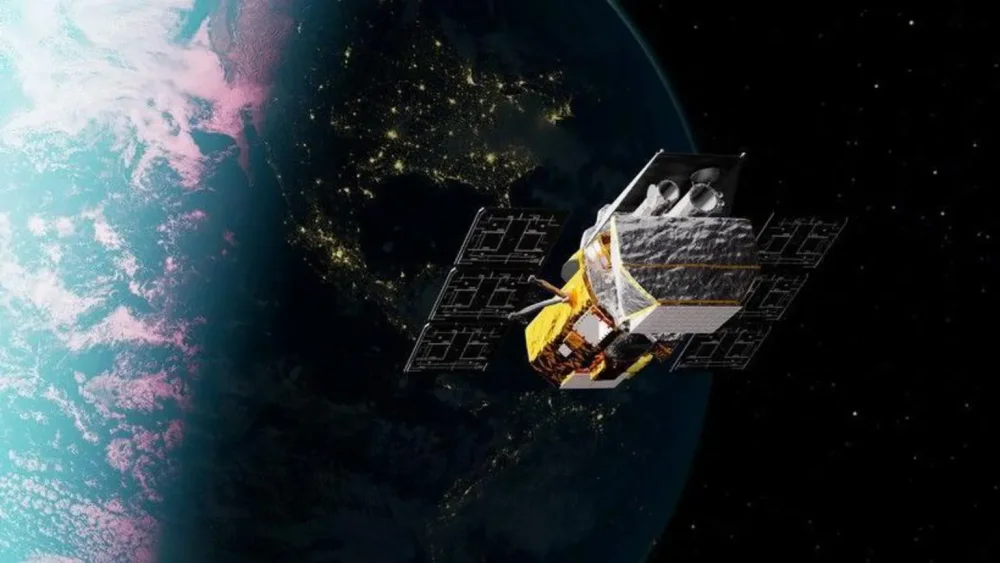
NASA has launched an ambitious space mission to prevent the Swift space telescope from gradually falling toward Earth. The agency has deployed a specialized robotic spacecraft that will attempt to stabilize and raise the telescope’s orbit, extending its scientific mission instead of allowing it to reenter Earth’s atmosphere.
The operation represents one of the most complex robotic servicing missions ever attempted in space and could reshape how aging satellites and scientific observatories are maintained in the future.
Swift Has Played a Vital Role in Space Research
NASA launched the Swift space telescope in 2004 to study some of the universe’s most energetic and short-lived cosmic events.
The observatory specializes in detecting gamma-ray bursts, powerful explosions that usually occur when massive stars collapse or when the remnants of dead stars collide. These events release enormous amounts of energy within seconds and provide scientists with valuable insights into the evolution of the universe.
Swift can rapidly detect these explosions and immediately direct its instruments toward them, making it one of astronomy’s most important space observatories.
Robotic Rescue Mission Underway
To preserve the telescope, NASA has deployed a robotic spacecraft called Link, developed by Katalyst Space Technologies.
The robot is equipped with three robotic arms, cameras, and precision navigation systems that will allow it to approach, inspect, and carefully capture the Swift telescope while both spacecraft continue traveling at high speed in orbit.
If the operation succeeds, Link will gradually raise Swift into a higher and more stable orbit, allowing the telescope to continue collecting valuable scientific data.
A Highly Complex Operation
The rescue mission presents significant engineering challenges because Swift was not originally designed for in-orbit servicing.
Engineers must guide Link close to a fast-moving spacecraft, securely capture it without causing damage, and safely perform orbital adjustments. Even small navigation errors could jeopardize both spacecraft.
The mission requires extremely precise autonomous navigation, robotics, and spacecraft control technologies.
Implications for Future Space Missions
If successful, the mission could establish a new model for extending the operational life of satellites and scientific spacecraft.
Rather than replacing expensive space observatories after orbital decay or technical issues, future missions could repair, refuel, reposition, or upgrade them using robotic servicing technologies. This approach could reduce costs, minimize space debris, and maximize the scientific value of existing space infrastructure.
The mission also supports the growing commercial space servicing industry, where robotic maintenance is expected to become increasingly important as more satellites enter orbit.
Looking Ahead
NASA’s effort to rescue Swift highlights the growing importance of sustainable space operations and advanced robotic technologies.
A successful outcome would not only preserve an important scientific instrument but also demonstrate that future spacecraft can receive maintenance long after launch. Such capabilities could play a key role in supporting long-term space exploration, satellite operations, and future missions to the Moon and beyond.
MORE STORIES:
 AI Voice-Cloning Scams Are Rising: How to Stay Safe
 Google Reports Surge in AI-Driven Cyberattacks by State Hackers
 Flip Phones Return With a Modern Purpose
 Nigeria Set to Pass Landmark AI Law
 AI Chatbots May Give Harmful Advice by Agreeing Too Much With Users
 OpenAI Revenue Surge Driven by GPT-5.4 as It Prepares for Public Listing
 Retailers Confront AI Return Fraud in Rising Damage Claims
 The Rise of AI for Everyone: Practical Benefits and Tools for Non-Tech Users
 Legal Concerns Rise Over AI Misuse in Personal Harassment Case
 Is AI-Generated Explicit Content Illegal in Rwanda?
Heya i’m for the first time here. I found this board and I find
It truly useful & it helped me out much. I hope to give something back and help others like you
helped me.
Hi there! This is my first visit to your blog!
We are a team of volunteers and starting a new initiative in a community in the same niche.
Your blog provided us valuable information to work on. You have done a wonderful job!
Hi there! I simply want to give you a big thumbs up for the great info you’ve got right here on this post.
I will be returning to your website for more soon.
Hi! I could have sworn I’ve been to this blog before but after looking at a few of
the posts I realized it’s new to me. Nonetheless, I’m certainly pleased I stumbled upon it and I’ll be book-marking it and checking back regularly!
유익하게 읽고 갑니다. 찾고 있던 부분인데 많이 배웠습니다.
종종 보러 올게요. 고맙습니다 🙂
Remarkable issues here. I’m very happy to look your article.
Thanks a lot and I’m taking a look ahead to touch
you. Will you kindly drop me a e-mail?
Usually I do not read post oon blogs, butt I wwish too ssay thatt thiis write-up very compelled mee tto
take a loook aat and ddo it! Your writing aste hass ben amkazed me.
Thanks, quite nkce article. ofvd9wuapt71e1fb2s52
What i do not realize is in truth how you are now not actually much
more smartly-liked than you might be now. You are so intelligent.
You know therefore significantly when it comes to this
topic, made me for my part consider it from a lot of numerous angles.
Its like men and women are not involved unless it is one
thing to accomplish with Girl gaga! Your individual stuffs excellent.
At all times handle it up!
Fastidious response in return of this matter with firm arguments and describing
all concerning that.
บทความนี้ มีประโยชน์มาก
ค่ะ
ผม เพิ่งเจอข้อมูลเกี่ยวกับ
เนื้อหาในแนวเดียวกัน
ที่คุณสามารถดูได้ที่ betflix
ลองแวะไปดู
มีการยกตัวอย่างที่เข้าใจง่าย
ขอบคุณที่แชร์ บทความคุณภาพ นี้
และหวังว่าจะมีข้อมูลใหม่ๆ มาแบ่งปันอีก
Thanks for sharing your thoughts on . Regards