




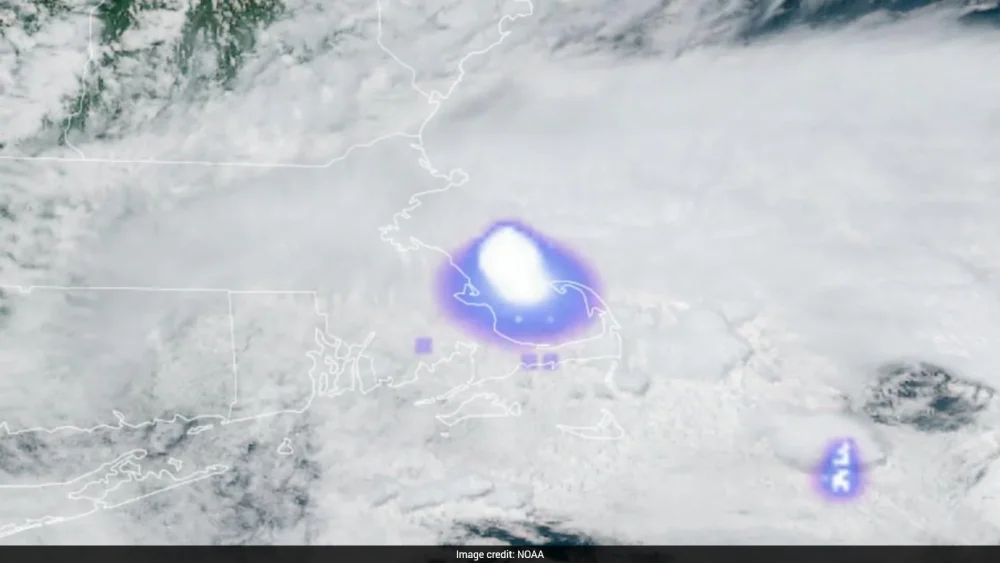
NASA has confirmed that a meteor exploded in the atmosphere above the northeastern region of the United States, creating a loud blast that shook homes across several states and raised concern among residents.
The event happened on Saturday afternoon at around 2:06 PM local time. Witnesses across parts of Massachusetts and New Hampshire reported seeing a bright fireball moving rapidly through the sky before a powerful explosion followed moments later. Many residents initially believed an earthquake or industrial explosion had occurred because of the strong sound waves and vibrations.
According to NASA, the meteor entered Earth’s atmosphere at a speed of more than 120,000 kilometers per hour. It later broke apart about 65 kilometers above the region north of Cape Cod in Massachusetts and southeastern New Hampshire.
The explosion released energy estimated to equal around 300 tons of TNT. Scientists explained that such force can generate shock waves strong enough to rattle buildings and create sounds similar to thunder or explosions on the ground.
Videos and images shared online showed the object glowing intensely as it crossed the sky. Several satellites and observation systems also captured the event, helping researchers confirm its origin and trajectory.
United States Geological Survey, commonly known as USGS, clarified that the vibrations reported by residents did not come from an earthquake. Instead, experts linked them directly to the atmospheric explosion caused by the meteor.
NASA officials also stressed that the object was not connected to recently observed unidentified aerial objects, human-made space debris, or a crashed spacecraft. The agency described it as a natural meteor entering Earth’s atmosphere.
Meteor explosions of this kind, sometimes called airbursts, occur when space rocks encounter intense pressure and heat while traveling through the atmosphere at extremely high speeds. Most meteors burn up before reaching the ground, although larger ones can occasionally leave fragments behind.
The incident has renewed public interest in planetary defense and space monitoring systems. Space agencies around the world continue investing in technologies designed to detect and track near-Earth objects earlier to reduce risks linked to larger impacts in the future.
Experts say events like this remain relatively rare, but they highlight the importance of international cooperation in monitoring activity in space. Improved satellite systems and observation networks now allow scientists to identify many objects before they enter Earth’s atmosphere.
Although the explosion caused concern and widespread discussion online, authorities reported no injuries or major damage linked to the incident.
MORE STORIES:
 The 10 Best Places to Travel in 2025
 Bruce Melodie: The Rise of Rwanda’s Music Icon – Biography, Career, and Achievements
 Fans Missing King James Tickets Promised New Option
 Kigali Universe to Open Frw900 Million Footbridge
 Who Is iShowSpeed, the Internet Star Visiting Rwanda?
 Karate Belt Ranking
 Kenyan Music Stars Bensoul and Nviiri The Storyteller to Perform in Kigali During UCI Road World Championships
 From Studio to Stardom: Yago Thrilled by Album’s Turnover
 Alyn Sano reflects on global connections at NAMM Show 2026
 A$AP Rocky Reveals His Mother Pushed Him to Date Rihanna Years Before Their Romance
6xc7mk
e2ivt0
e2oand
95a1ly
cf6uvo