




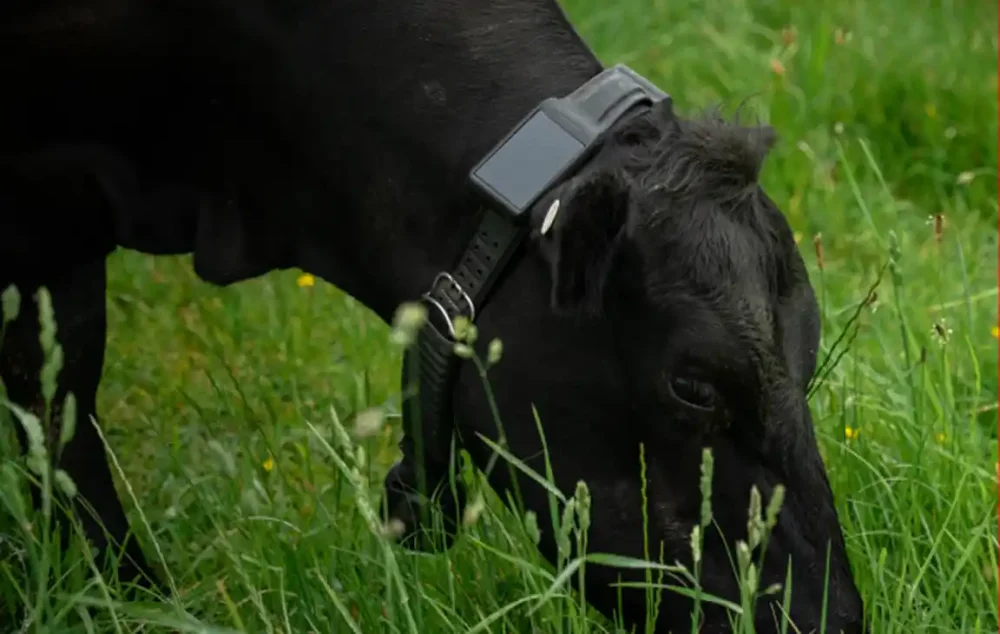
Agricultural technology company Halter has introduced an innovative livestock management system that enables farmers to guide and monitor large herds of cattle using a smartphone.
Founded in 2016 in New Zealand by Craig Piggott, Halter has grown rapidly and is now valued at approximately $2 billion. The company currently operates in New Zealand, Australia, and the United States, where demand for smart farming solutions continues to increase.
Its technology aims to reduce labor demands while improving efficiency and animal management on modern farms.
How Virtual Fencing Works
Halter uses a system known as virtual fencing, which replaces traditional physical fences with digital boundaries.
Each cow wears a GPS-enabled collar powered by solar energy. Through a mobile application, farmers can create invisible boundaries and manage grazing areas remotely.
When an animal approaches a designated boundary, the collar emits an audio signal that encourages it to move in a different direction. If the animal ignores the sound, the collar delivers a mild corrective stimulus designed to guide movement safely.
Over time, cattle learn to respond to the audio cues, allowing farmers to direct entire herds with minimal intervention.
Faster Herd Management and Improved Productivity
Managing large groups of cattle traditionally requires significant time and labor. Moving herds across grazing areas can often take hours, especially on large farms.
Halter’s system significantly reduces this workload by enabling farmers to reposition more than 100 cattle within minutes through a smartphone interface.
The technology also helps optimize grazing patterns, ensuring pasture resources are used more efficiently while reducing operational costs.
Real-Time Monitoring Through GPS Technology
The platform uses satellite-based GPS technology to provide accurate location tracking for every animal in a herd.
Farmers can view cattle positions in real time and receive valuable insights into movement patterns, grazing behavior, and overall herd activity.
This data-driven approach allows livestock owners to make faster decisions and identify potential issues before they become serious problems.
Benefits for Modern Livestock Farming
The adoption of smart livestock technologies offers several advantages for farmers. Virtual fencing eliminates the need to build and maintain extensive physical fences, reducing infrastructure expenses.
In addition, farmers can monitor their cattle from virtually anywhere, improving flexibility and reducing dependence on full-time herding staff.
The system also provides health and behavioral data that can support better animal welfare and farm management practices.
Opportunities and Challenges
As precision agriculture continues to expand, technologies such as Halter could play an important role in improving productivity and sustainability in livestock farming.
However, widespread adoption may depend on factors such as equipment costs, internet connectivity in rural areas, and farmer training.
Despite these challenges, growing interest in agricultural innovation suggests that digital livestock management systems could become increasingly common across global farming industries.
Future Outlook
The success of Halter highlights the growing role of technology in agriculture. As farmers face pressure to increase productivity while managing costs, solutions that combine GPS tracking, automation, and data analytics may become essential tools for the future of livestock farming.
Continued advances in smart agriculture could help farmers improve efficiency, strengthen animal welfare, and make better use of natural resources.
MORE STORIES:
 Understanding Computer Viruses and Their Impact
 AI Chatbots May Give Harmful Advice by Agreeing Too Much With Users
 OpenAI Explores Spacecraft Project
 Is AI-Generated Explicit Content Illegal in Rwanda?
 Data Curation for AIOps: The Key to Smarter Network Operations
 AI safety debate grows as parents demand online child protection
 Nigeria Set to Pass Landmark AI Law
 Retailers Confront AI Return Fraud in Rising Damage Claims
 Legal Concerns Rise Over AI Misuse in Personal Harassment Case
 Google Reports Surge in AI-Driven Cyberattacks by State Hackers
aah8zf
xol29u
vlh283
ff7a4m