




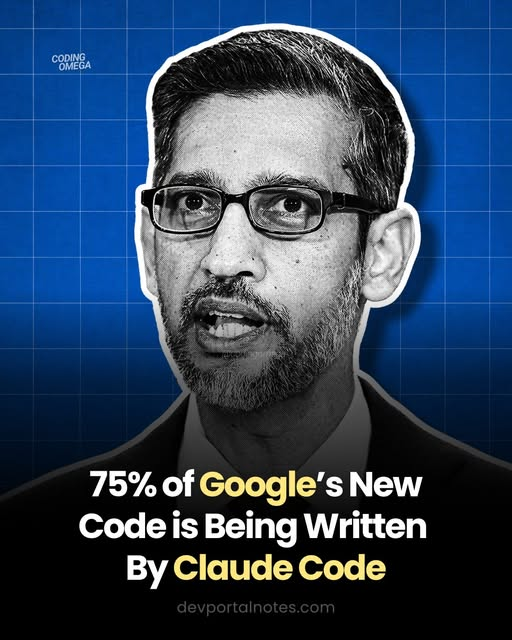
Google has confirmed a major shift in its software development process as artificial intelligence now generates the majority of its new code. According to CEO Sundar Pichai, about 75 percent of all new code at Google comes from AI systems and receives review and approval from human engineers.
This marks a significant increase compared to previous years. AI generated code accounted for around 50 percent of new code last fall and just over 30 percent a year ago. The rapid growth shows how quickly artificial intelligence has become a central part of Google’s engineering operations.
Engineers shift from writing to reviewing code
Instead of writing code from scratch, engineers now focus on reviewing, modifying, and approving AI-generated outputs. This change shifts their role toward what Google describes as “agentic workflows,” where AI systems handle repetitive tasks while humans guide, refine, and validate the final output.
This approach allows developers to focus more on system design, problem solving, and quality control rather than manual coding.
AI accelerates complex engineering tasks
Google also reported a major milestone in its internal systems. A recent complex code migration project was completed six times faster using AI agents alongside human engineers.
The company says this improvement highlights how AI tools can significantly speed up large-scale engineering work while maintaining accuracy through human oversight.
Implications for the tech industry
This development reflects a broader transformation in the global software industry. Companies increasingly use AI to boost productivity, reduce development time, and improve efficiency.
However, it also raises important questions about workforce adaptation. Engineers must now develop skills in AI supervision, system design, and workflow orchestration rather than only traditional programming.
Opportunities and risks
The rise of AI-assisted coding creates several opportunities. It increases development speed, reduces repetitive work, and allows faster innovation cycles. Businesses can bring products to market more quickly and at lower cost.
At the same time, it introduces risks. Overreliance on AI systems may lead to errors if human review becomes weak. It also requires strong governance to ensure code quality, security, and ethical use of AI-generated outputs.
Future outlook
Google’s approach signals a future where AI becomes a core partner in software engineering. Human engineers will remain essential, but their role will continue to evolve toward supervision and strategic decision-making.
As AI tools become more advanced, more companies are likely to adopt similar workflows, reshaping how software is built across the technology industry.
MORE STORIES:
 Job Opportunity at King Faisal Hospital Rwanda
 Beyond Market Cap: How Pi Network’s $34 Quadrillion Utility Vision Could Redefine Crypto
 Long toilet sitting and hemorrhoids
 INNOVATION ECOSYSTEM COORDINATOR JOB
 OpenAI Enters the Cybersecurity AI Race
 OpenAI’s Value Reaches $500 Billion
 Apple Introduces RCS Messaging Support in iOS 26.5 Update
 Job opportunities at unguka
 Colombian President Criticizes U.S. After Losing Visa
 Pi Network Sets Its Sights on Global Blockchain Leadership with Open Network Launch
I’m curioous too finhd oout whzt blog systdm yoou have
been utilizing? I’m having sone mimor secxurity issues wth my
atest bog aand I woild ike too fin somsthing mkre safeguarded.
Do youu hhave anyy solutions?