




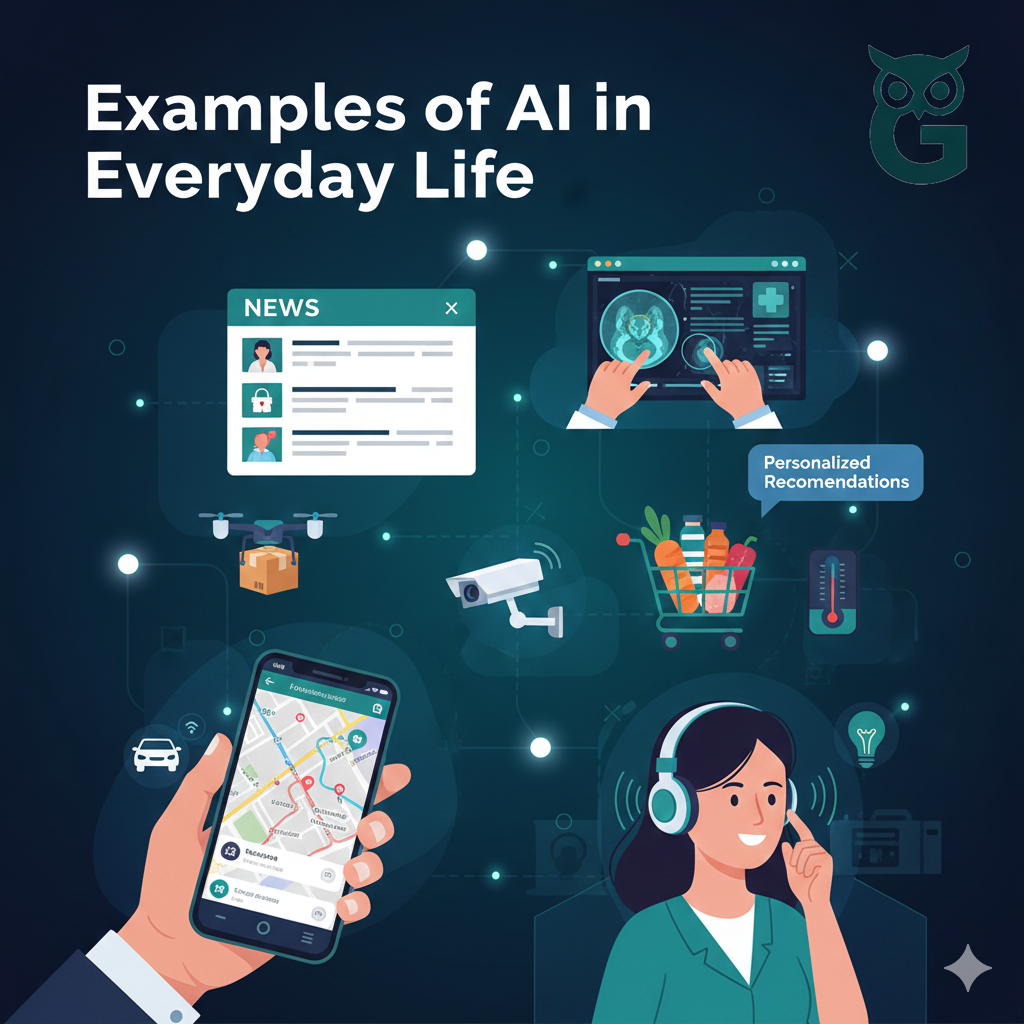
Artificial Intelligence (AI) has become an integral part of everyday life. Today, people interact with AI-driven systems more often than they realise. From smartphones and online shopping to navigation and finance, AI quietly improves speed, accuracy, and convenience.
As technology advances, AI continues to reshape how individuals work, communicate, and make decisions. Understanding its real-world applications helps explain why AI is no longer optional but essential.
Artificial Intelligence refers to computer systems designed to perform tasks that typically require human intelligence. These tasks include learning from data, recognising patterns, solving problems, and making decisions. Most modern AI relies on machine learning, which allows systems to improve over time. While AI cannot think creatively like humans, it excels at efficiency and consistency once trained.
Facial recognition is one of the most visible examples of AI in daily life. Smartphones now unlock using facial scans, even in low light or with accessories like glasses. In addition, social media platforms use AI-powered facial mapping to support augmented reality features such as filters and effects. As a result, everyday interactions with mobile devices feel faster and more intuitive.
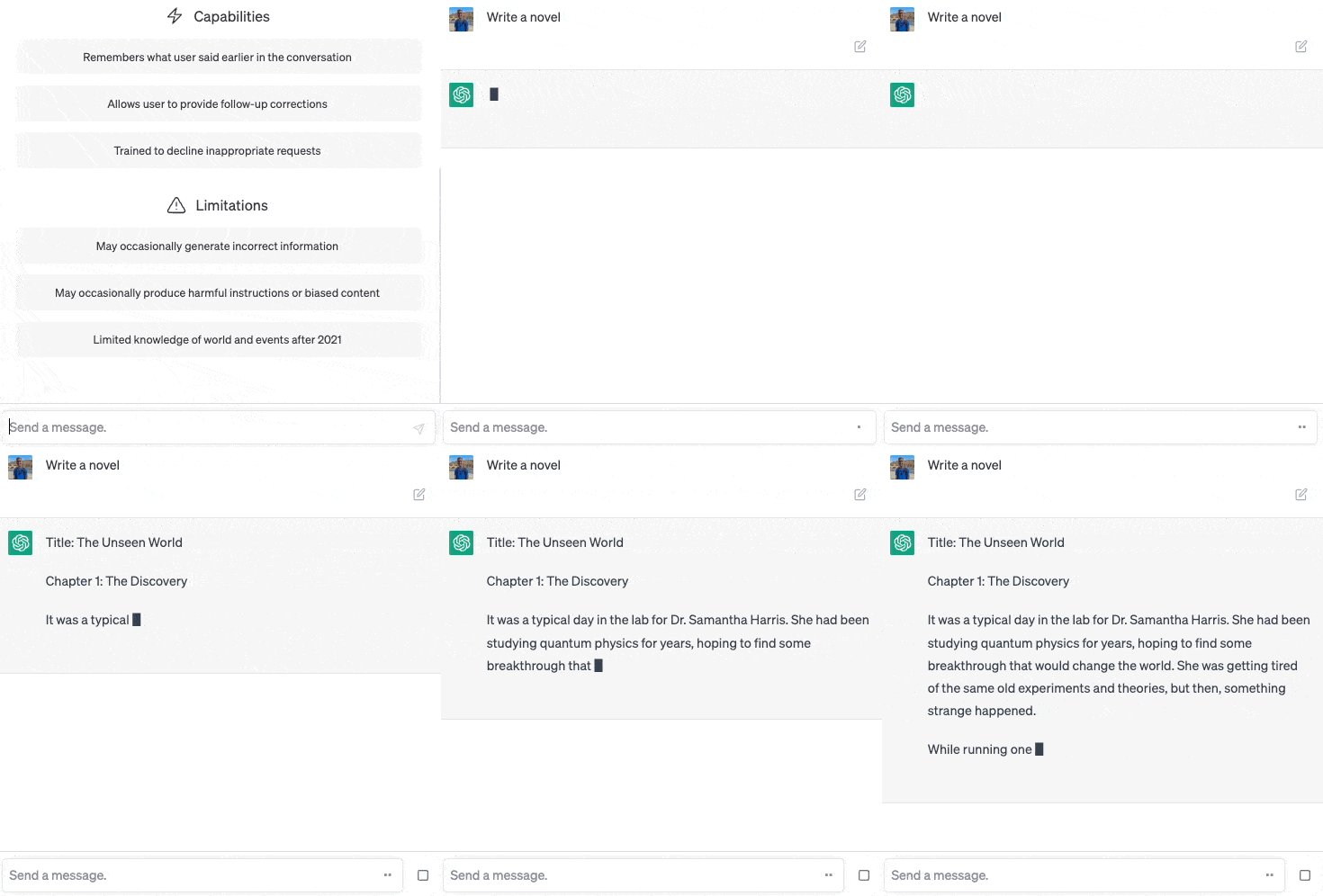
Content creation has also changed dramatically because of AI. Tools such as ChatGPT assist users in writing articles, marketing copy, and social media posts within seconds. Moreover, AI now generates images, videos, and advertisements that closely resemble human-made content. Although human editing remains important, AI significantly reduces production time.
Search engines rely heavily on AI to deliver accurate and personalised results. Instead of focusing only on keywords, AI interprets user intent and context. For example, it analyses language patterns, search history, and location. Consequently, users receive more relevant results with less effort.

Social media platforms depend on AI to recommend content, filter harmful material, and personalise user feeds. At the same time, businesses and influencers use AI tools to analyse engagement and optimise campaigns. This approach allows creators to reach wider audiences more efficiently.
Writing and grammar tools powered by AI help users communicate more clearly. Applications like Grammarly correct spelling, improve sentence structure, and suggest better tone choices. Additionally, these tools learn from user behaviour, which improves accuracy over time.

Virtual assistants represent another common AI application. Google Assistant and Amazon Alexa answer questions, manage schedules, and control smart home devices. Over time, they adapt to speech patterns, accents, and preferences, making interactions more natural.
Chatbots have transformed customer service across industries. They respond instantly, analyse queries, and provide accurate solutions at any hour. As a result, companies reduce costs while improving customer satisfaction.
In finance, AI strengthens fraud detection by identifying suspicious activity in real time. Banks also use AI for credit scoring, financial planning, and market analysis. Meanwhile, investors rely on AI to evaluate trends and manage risk more effectively.

E-commerce platforms use AI to personalise shopping experiences. AI recommends products, tracks inventory, and answers customer questions. Consequently, businesses increase sales while customers enjoy smoother online experiences.
Transportation is another area where AI plays a major role. Navigation apps use AI to analyse traffic patterns and suggest faster routes. In addition, self-driving vehicle technology continues to advance, promising safer and more efficient mobility in the future.
In conclusion, AI already shapes everyday life in powerful ways. From communication and finance to transport and entertainment, AI continues to enhance efficiency and decision-making. As adoption grows, understanding these applications becomes increasingly important.
MORE STORIES:
 Nvidia doubles down on AI agents
 Mark Zuckerberg Develops AI Agent to Transform Meta’s Operations
 AI and Drones Could Help African Projects Secure Investment Faster
 AI Won’t Replace Humans; But Humans With AI Will Replace Humans Without AI
 Africa and the AI Race: Analyzing Competitiveness
 Companies Turn to AI for Smarter Decision-Making
 Is AI-Generated Explicit Content Illegal in Rwanda?
 SAP Report Warns Africa Must Accelerate AI Skills Development
 Struggling Doesn’t Make You Smarter. Using AI Does
 Three Teen Girls Sue Grok AI Over Alleged Use of Their Images in Explicit Deepfakes
Hiya, I am really glad I’ve found this information. Nowadays bloggers publish only about gossips and web and this is actually annoying. A good site with interesting content, that’s what I need. Thanks for keeping this web site, I’ll be visiting it. Do you do newsletters? Can’t find it.
I would like to thnkx for the efforts you have put in writing this blog. I am hoping the same high-grade blog post from you in the upcoming as well. In fact your creative writing abilities has inspired me to get my own blog now. Really the blogging is spreading its wings quickly. Your write up is a good example of it.
Heyya i am foor thhe firest tiume here. I found
tuis boaed andd I iin findding It really helpful & itt helped me out a lot.
I’m hkping tto present ssomething bacxk andd help others such
as yyou aidwd me.