


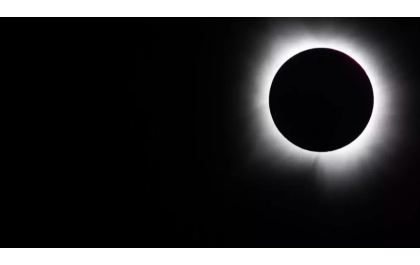
Millions of people across Europe are expected to witness a rare total solar eclipse on Wednesday, August 12, 2026, with parts of Spain set to fall into darkness during daylight hours.
A solar eclipse occurs when the Moon passes between Earth and the Sun, blocking some or all of the Sun’s light. During a total solar eclipse, the Moon completely covers the visible disk of the Sun for a short period.
Spain set to witness total darkness
The Moon’s shadow is expected to begin crossing remote parts of northern Russia at around 17:00 GMT, or 19:00 in Kigali. It will then move across Greenland and Iceland before reaching Europe.
Spain is expected to become the only European country where the total phase of the eclipse will be clearly visible. The path of totality will cross northern parts of the country before moving toward the Mediterranean coast.
The total eclipse in Spain will last less than two minutes and will occur shortly before sunset. In parts of Russia and Greenland, totality will last slightly longer, although it will remain below two and a half minutes.
A partial eclipse will also be visible across much of Europe, Canada, northern parts of the United States and northwestern Africa.
A rare event for Europe
The 2026 eclipse marks the first time since 2006 that a total solar eclipse will be visible from European land. Spain has an even longer wait, with more than a century having passed since some parts of the country last experienced a comparable event.
British solar scientist Lucie Green described total solar eclipses as powerful experiences that can leave people wanting to see them again.
The eclipse is expected to create noticeable changes in the environment. Daylight will temporarily become darker, temperatures can fall, shadows may appear unusual and some animals may behave as if night has arrived.
Scientists prepare to study the Sun
Beyond its visual appeal, the eclipse will provide researchers with an opportunity to observe the Sun and its surrounding atmosphere.
The partial eclipse is expected to last for about one hour and 45 minutes. Scientists can use eclipse observations to study the solar atmosphere, solar winds and the Sun’s magnetic field.
Total eclipses also allow researchers to observe the solar corona, the outer atmosphere of the Sun, which becomes difficult to see when the Sun is not eclipsed.
These observations can contribute to a better understanding of solar activity and its potential effects on technologies and communication systems on Earth.
Spain prepares for a tourism surge
The eclipse has already created significant interest in Spain, with people travelling to areas expected to have clear views of totality.
Demand for specialized solar viewing glasses has reportedly increased, with supplies becoming limited in some locations. Authorities have also prepared designated viewing areas and increased security measures.
The event is expected to provide an economic boost to Spain’s tourism sector. The country’s Ministry of Economy estimates that the eclipse could generate about €347 million, partly because of an expected increase of more than 446,000 visitors.
In Benavente, a city in northwestern Spain, accommodation has reportedly become difficult to find as visitors arrive ahead of the event.
Authorities also expect as many as 1.5 million additional vehicle journeys toward areas within the path of totality. This has prompted preparations for increased traffic, public safety and crowd management.
What comes next?
The 2026 eclipse is not the only major solar event expected in the region.
Another total solar eclipse is scheduled to cross southern Spain and parts of North Africa in August 2027. In 2028, another major eclipse will feature a ring of sunlight around the Moon, known as an annular solar eclipse.
For scientists, tourism businesses and astronomy enthusiasts, the sequence of events could create several years of increased interest in solar observation and eclipse tourism.
However, anyone planning to observe a solar eclipse should use certified solar viewing equipment. Looking directly at the Sun without proper eye protection can cause serious and permanent eye damage.